

Neoclassical Architecture: Features, History & Examples
Neoclassical architecture emerged in the mid-18th century, reviving Greek and Roman forms as an expression of Enlightenment ideals. This overview covers its defining features, historical development, key buildings, and how to distinguish it from related classical styles.
 illustrarch Editoral Team19 October 20268 Mins read5
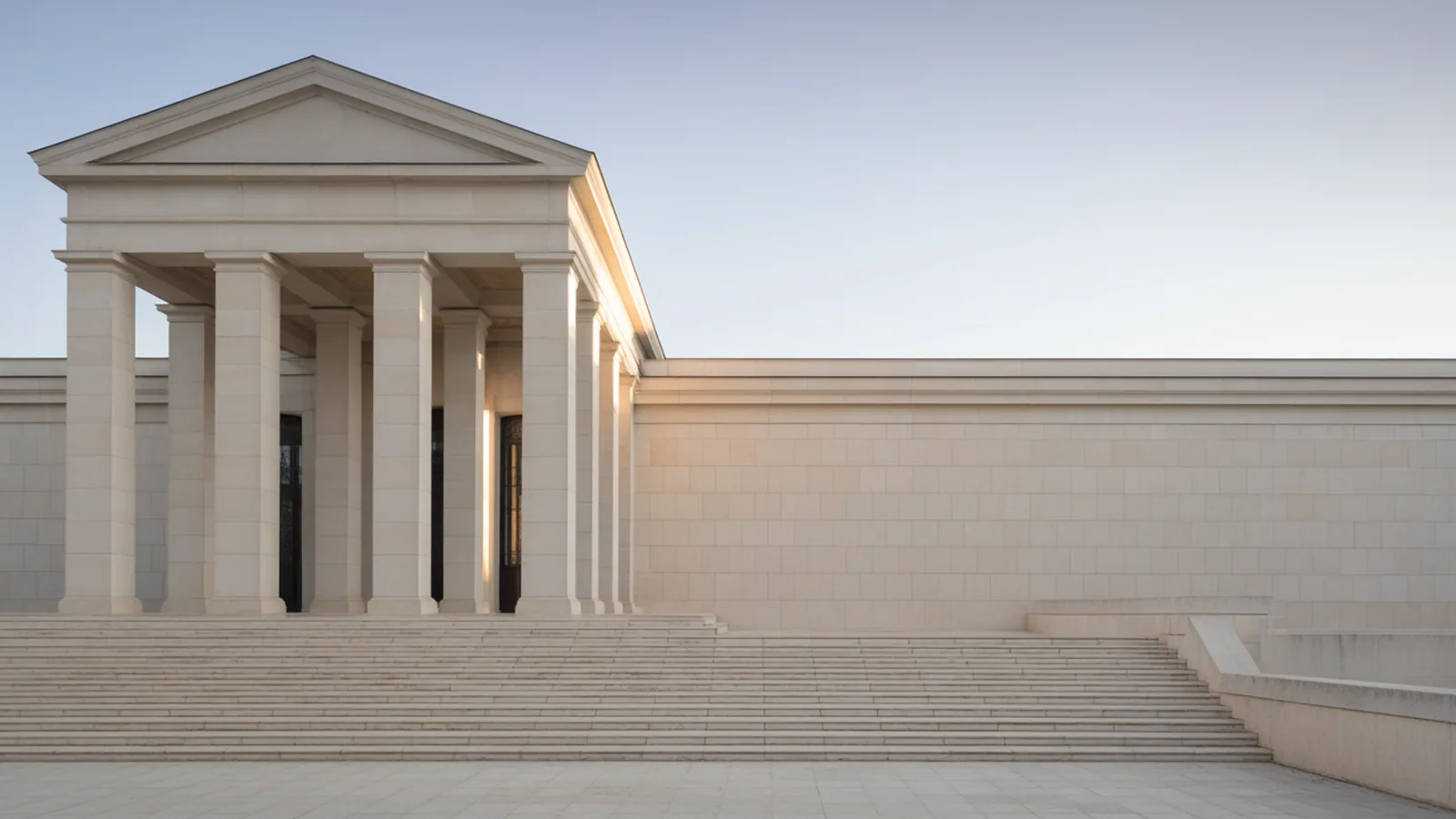
Table of Contents Show
Neoclassical architecture is a style that emerged in the mid-18th century as a deliberate return to the forms and principles of ancient Greece and Rome. Defined by columns, pediments, symmetrical facades, and restrained ornamentation, it shaped some of the most recognizable civic buildings on earth and remains influential in government, cultural, and institutional design today.
What Is Neoclassical Architecture?
Neoclassical architecture draws directly from the classical antiquity of Greece and Rome, reviving the formal language of temples, porticos, and colonnaded halls. Unlike the earlier Renaissance revival, which reinterpreted classical elements loosely, neoclassicism aimed for archaeological accuracy and rational clarity. Architects working in this tradition stripped away the exuberance of Baroque and Rococo styles in favor of clean geometry, ordered proportions, and surfaces that let structure speak for itself.
The style is rooted in Enlightenment philosophy. As 18th-century thinkers championed reason, civic virtue, and universal principles, architects saw ancient Rome and Greece as the physical embodiment of those ideals. A courthouse or parliament building rendered in neoclassical form was not just a functional space; it was an argument about governance and civilization.
📌 Did You Know?
The excavations at Herculaneum (begun 1738) and Pompeii (begun 1748) sent shockwaves through European culture. For the first time, architects and patrons had direct visual evidence of Roman domestic and civic design, fueling demand for buildings that looked authentically ancient rather than freely interpreted. According to the Encyclopedia Britannica, these discoveries were a primary catalyst for the neoclassical movement across Europe and beyond.
Historical Origins and Development
The movement’s intellectual groundwork was laid by theorists such as the German art historian Johann Joachim Winckelmann, whose 1755 essay “Reflections on the Imitation of Greek Works in Painting and Sculpture” argued that Greek art represented the pinnacle of aesthetic achievement. His work gave architects a theoretical foundation for pursuing simplicity and noble grandeur over decorative complexity.
In France, architect Jacques-Germain Soufflot applied these ideas at the Pantheon in Paris (construction began 1758, completed 1790), combining a monumental dome with a Greek-cross plan and a colonnade of Corinthian columns along the facade. The building became one of the defining statements of French neoclassicism and was repurposed as a mausoleum for distinguished citizens of the Republic, cementing its association with civic ideals.
In Britain, the Palladian tradition had already introduced a restrained classicism in the early 18th century through architects such as Colen Campbell and William Kent. By the 1760s, Robert Adam developed a lighter, more decorative neoclassical interior style that spread rapidly across country houses and urban terraces. At the same time, the Greek Revival, which prioritized Doric columns and unadorned stone surfaces over the more ornate Roman vocabulary, took hold in the early 19th century across Scotland, Germany, and the United States.

In the United States, neoclassicism became virtually synonymous with democratic government. Thomas Jefferson, who had visited the Maison Carree temple in Nimes, France, drew directly on it when designing the Virginia State Capitol (completed 1788). Later, architects William Thornton, Benjamin Henry Latrobe, and Charles Bulfinch produced the US Capitol, a building whose dome, colonnades, and sandstone facades made neoclassicism the visual language of American republicanism.
🔢 Quick Numbers
- Construction of the Pantheon in Paris began in 1758 and took 32 years to complete, with the dome rising to approximately 83 meters (272 feet) above street level (Source: Centre des Monuments Nationaux)
- The US Capitol cast-iron dome stands 88 meters (289 feet) above the East Front Plaza; it replaced the original wooden structure between 1855 and 1866 (Source: Architect of the Capitol)
- The Brandenburg Gate in Berlin, completed in 1791, features 12 Doric columns arranged in five passageways and is modeled directly on the Propylaea gateway to the Athenian Acropolis (Source: Wikipedia, Neoclassical Architecture)
Key Features of Neoclassical Architecture
Identifying neoclassical buildings is straightforward once you know what to look for. The style is consistent in its vocabulary, even if it varies by region and period.
Columns and Classical Orders
Columns are the signature element of neoclassical architecture. Buildings typically display one or more of the three Greek orders: Doric (plain, sturdy capitals), Ionic (scroll-shaped capitals), or Corinthian (acanthus-leaf capitals). Roman variants of these orders, including the Composite and Tuscan, also appear. Columns may be freestanding, engaged (partially embedded in a wall), or arranged as a full colonnade spanning the facade.
Pediments and Entablatures
Above the columns sits the entablature, a horizontal band comprising the architrave, frieze, and cornice. Crowning many neoclassical facades is the triangular pediment, borrowed directly from Greek temple fronts. The pediment is often left plain or filled with relief sculpture depicting allegorical or historical subjects. This arrangement is visible on courthouses, banks, and museums across Europe and North America.
Symmetry and Axial Planning
Symmetry is fundamental. Neoclassical buildings are almost always planned around a central axis, with identical elements mirrored on either side. This applies to facades, floor plans, and garden layouts. The rigidity of the grid and the balance of masses convey order and permanence, qualities that made the style appealing to governments and institutions projecting authority.
Restrained Ornamentation
Compared to the Baroque and Rococo styles that preceded it, neoclassical decoration is spare. Surfaces are smooth or lightly articulated. Where ornament appears, it derives directly from classical sources: egg-and-dart moldings, Greek key borders, laurel wreaths, and acanthus leaves. Gilded excess is absent; the beauty lies in proportion rather than surface richness.
Grand Domes and Rotundas
Many major neoclassical civic buildings incorporate a dome, referencing the Pantheon in Rome. The dome signals civic importance and creates a focal point visible from a distance. Inside, the rotunda below the dome often serves as a ceremonial space. This combination appears at the US Capitol, the Pantheon in Paris, and Thomas Jefferson’s Rotunda at the University of Virginia.
🏗️ Real-World Example
Pantheon, Paris (France, 1790): Designed by Jacques-Germain Soufflot, the Pantheon exemplifies French neoclassical ambition. Its Corinthian portico of 22 columns, shallow dome, and Greek-cross plan were intended to rival St. Peter’s Basilica in Rome while expressing Enlightenment rationalism. Today it serves as a mausoleum housing the remains of figures including Voltaire, Rousseau, Victor Hugo, Marie Curie, and Josephine Baker, making it one of the most symbolically charged neoclassical interiors anywhere.
How Do You Identify a Neoclassical Building?
Not every building with columns is neoclassical, so it helps to consider the full picture. Run through this checklist when examining an unfamiliar structure:
- Does the facade feature columns from a recognizable classical order (Doric, Ionic, Corinthian)?
- Is there a triangular pediment above the main entrance or colonnade?
- Is the plan rigorously symmetrical around a central axis?
- Is the surface decoration minimal and derived from Greek or Roman motifs?
- Does the building have a prominent dome or rotunda?
- Was it built roughly between 1750 and 1900 (the core neoclassical period)?
A building that checks four or more of these boxes is almost certainly neoclassical. Bear in mind that later revivals of the style, sometimes called “classical revivalism,” continued into the 20th century, particularly in state architecture in the United States and Europe.

💡 Pro Tip
A common mistake when identifying neoclassical buildings is confusing them with Baroque or Beaux-Arts examples. If a building has elaborate sculptural decoration, exaggerated curves, and a busy roofline with statuary, it is more likely Baroque or Beaux-Arts. Neoclassical facades read as calm and horizontal, with the column rhythm doing the visual work rather than surface ornament. Step back and assess the overall silence of the wall surface first.
Notable Neoclassical Buildings Around the World
The reach of neoclassical architecture is global. Below are some of the most significant examples, spanning two centuries and multiple continents.
United States Capitol, Washington D.C. (1800, expanded 1855-1866)
Few buildings carry more political symbolism. The Capitol’s east and west facades feature full colonnades of Corinthian columns, a sandstone and marble body, and the famous cast-iron dome completed in 1866. The design draws on both Roman temples and the Pantheon in Paris and was shaped by a succession of architects including William Thornton, Benjamin Henry Latrobe, Charles Bulfinch, and Thomas U. Walter. For architecture enthusiasts, it is worth examining alongside other landmark buildings designed by architects who shaped history.
Brandenburg Gate, Berlin, Germany (1791)
Designed by Carl Gotthard Langhans for King Frederick William II of Prussia, the Brandenburg Gate is a direct reference to the Propylaea, the gateway to the Athenian Acropolis. Its five passageways are defined by twelve Doric columns, and the whole composition sits beneath a sandstone attic bearing a quadriga sculpture. The gate has served as a backdrop for momentous political events over more than two centuries, from Napoleonic occupation to the fall of the Berlin Wall in 1989.
British Museum, London, UK (1847)
Robert Smirke’s main facade for the British Museum presents one of the largest Greek Revival colonnades in the world: 44 Ionic columns stretching across the Great Russell Street frontage. The design was inspired by the Greek temples at Paestum and reflects the early 19th-century British fascination with ancient Greece following the arrival of the Elgin Marbles. The building is classified as a Grade I listed structure by Historic England.
Altes Museum, Berlin, Germany (1830)
Karl Friedrich Schinkel’s Altes Museum is considered by many architectural historians to be one of the purest expressions of neoclassical design. An 18-column Ionic colonnade spans the full width of the facade, opening into a central rotunda modeled on the Roman Pantheon. Schinkel also designed the Neue Wache (1818) and the Schauspielhaus (1821) in Berlin, making him the defining neoclassical architect of Prussia and one of the most important figures in the neoclassical architecture tradition in Europe.
What Is the Difference Between Neoclassical and Greek Revival Architecture?
Greek Revival is a subset of neoclassical architecture, not a separate movement. Where neoclassicism draws on both Greek and Roman precedents, Greek Revival specifically prioritizes Greek models: temples, colonnaded stoas, and the Doric order in its most austere form. Greek Revival buildings tend to have low-pitched roofs, wide horizontal porticos, and minimal surface relief, giving them a heavier, more earthbound quality than buildings inspired by Roman precedents with their taller arches and domed interiors.
The Greek Revival reached its peak between roughly 1820 and 1850, particularly in Scotland (where Edinburgh’s New Town earned the city the nickname “Athens of the North”), Germany (through Schinkel’s work in Berlin), and the American South and Midwest, where civic buildings alike adopted its vocabulary. For a broader look at how architectural styles travel and transform, ArchDaily’s neoclassical architecture coverage documents both historical examples and contemporary projects engaging with the tradition.
Neoclassical Architecture’s Legacy and Modern Relevance
Neoclassicism has outlasted almost every other historical revival because it speaks a language that feels permanent. Columns, pediments, and symmetrical facades carry associations of order, reason, and civic responsibility that transcend any particular century or culture. When a new government or institution wants to signal stability and legitimacy, it often reaches for the same vocabulary that Soufflot and Jefferson used.
That said, the style has also attracted criticism. Its association with authoritarian regimes, including fascist Italy and Nazi Germany, which appropriated stripped neoclassicism for their monumental architecture, has complicated its legacy. Albert Speer’s unrealized plans for a “Germania” and the EUR complex in Rome both drew on neoclassical massing while emptying it of democratic meaning.
Today, neoclassicism occupies contested ground in architectural debate. A growing number of architects and institutions, particularly in the United States and United Kingdom, advocate for its return in civic contexts. Critics counter that historical forms should not be imposed on contemporary programs. What is not in question is the style’s analytical value: for anyone studying how buildings make arguments about power, culture, and identity, neoclassical architecture remains one of the richest fields available. The Metropolitan Museum of Art’s Heilbrunn Timeline of Art History explores this broader context at metmuseum.org.

✅ Key Takeaways
- Neoclassical architecture emerged in the mid-18th century as a reaction against Baroque and Rococo excess, directly inspired by archaeological discoveries at Pompeii and Herculaneum.
- Core features include classical columns (Doric, Ionic, or Corinthian), triangular pediments, strict bilateral symmetry, minimal ornamentation, and prominent domes or rotundas.
- The style became the visual language of democratic government in the United States and civic institutions across Europe from roughly 1750 to 1900.
- Key examples include the US Capitol, the Pantheon in Paris, the Brandenburg Gate in Berlin, the British Museum in London, and the Altes Museum in Berlin.
- Greek Revival is a subset of neoclassical architecture, favoring Greek over Roman models; Beaux-Arts is a later, more ornate offshoot with richer surface decoration.
📚 Part of our guide to Architectural Styles: A Complete Guide Through History. See also Greek Revival Architecture: Features & Examples and Renaissance Architecture: Features, History & Examples.





Craftsman Architecture: Features, History & Examples
Craftsman architecture emerged in early 1900s America as a response to Victorian...
illustrarch Editoral Team10 Mins read

Florence Renaissance Architecture: How Building Became an Authored Art
Florence Renaissance architecture is usually told as a list of buildings. The...
 Furkan Sen6 Mins read

Architectural Styles History: Why Some Styles Fail and Others Endure
A look at architectural styles history through the decisions that actually keep...
Furkan Sen6 Mins read
Architectural Styles: Why Some Endure and Others Fade
Some architectural styles last for centuries while others are demolished within a...
Furkan Sen5 Mins read


Leave a comment