

SEO for Architects: A Practical Guide to Project Pages, Local Search and Specialist Agencies
A practical SEO plan for architecture practices: project pages that rank, indexable portfolio images, Google Business Profile rules, ArchDaily and Dezeen submissions, schema markup and measurement, plus six specialist agencies with published prices.
 Begum Gumusel1 July 202415 Mins read657

Table of Contents Show
SEO for architects is the work of making a practice’s project pages, photographs and Google Business Profile easy for Google to read and trust, so that people looking for an architect for a building type in a place find you. It rests on four things: crawlable project pages, indexable images, an accurate local profile and links from respected publications.
Most practices already own what search engines reward: built work, good photography, drawings and a real address. What goes wrong is the packaging. A portfolio built as one full-screen slideshow, a contact page without an address and a Business Profile that still shows an old phone number all leave Google guessing about what you do and where.
This guide stays on the search side of that problem. Referrals, social media and proposals belong to our guide on marketing for architects, and keyword grouping with a 90-day plan is in our companion piece on SEO for architecture firms. Here you get the parts that most often break on an architecture website, the rules Google publishes for each of them, and six agencies that work specifically with architecture and design practices.
What Google Needs From an Architecture Website
Google’s own SEO Starter Guide reduces the job to three tasks: help Google find your pages, help it understand them, and make them useful once a person lands. For a practice, that splits into three kinds of work:
- On-page: the title, text, headings and images of each page, starting with project and service pages.
- Off-page: links and mentions from other sites, from ArchDaily features to your engineer’s project list.
- Technical: speed, mobile layout and whether Google can crawl the gallery at all.
An audit shows where each layer stands before you spend money. The Website SEO Checker by SE Ranking, for example, checks on-page factors, runs a technical audit and lists backlinks in one report, while Google Search Console covers indexing and real search queries for free once you verify the site. A practice website rarely needs every fix at once; it needs the few that stop project pages from being found.
📌 Did You Know?
NCARB’s By the Numbers 2022 report counted 121,603 licensed architects in the United States in 2021. Over the previous five years the number of licensed architects rose 7% according to the report, while the US population grew 2%, so there are slightly more architects per person competing for the same local searches.
Project Pages: The Unit Architecture SEO Is Built On
For a practice, the project page does the job a product page does in retail. Clients rarely search for a firm’s name. They search for a building type in a place, such as a passive house architect in Bristol or a school extension architect in their county, and each finished project is proof for one of those combinations. Give it a URL of its own instead of a slide in a shared gallery.
Name, URL and title tag
Use the project’s real name plus type and place: /projects/hillside-house-kitchen-extension-bath/ tells Google far more than /portfolio/project-07/. The title tag follows the same pattern (“Hillside House: Kitchen Extension in Bath | Studio Name”), and the page heading repeats the project name. Keep one project per URL; a gallery that loads every project into a single page gives Google one page to rank for twenty different searches.
Write the text a client and an editor both need
Photographs alone do not tell Google, or a client, what was built. A few hundred words that cover the brief, the site constraint, the decision that shaped the design, the main materials, the floor area and the outcome turn a picture set into a page that can rank. Our piece on telling a strong story for your project covers the writing side; the table below covers what each part of the page should carry.
What a project page should contain
Use this as a checklist when you rebuild an existing portfolio:
| Element | What to write | Why it matters |
|---|---|---|
| URL and title | Project name, building type, town | Matches how clients phrase searches |
| Opening paragraph | Brief, site and the main design move | Gives Google and editors the story fast |
| Facts block | Location, completion year, area, client type | Answers the questions buyers screen for |
| Images | Descriptive filenames, alt text, captions | Makes photos indexable in Google Images |
| Credits | Photographer, engineer, contractor, with links | Publications require them; partners link back |
| Internal links | Link to the matching service page and back | Shows Google which page is the hub |
The internal links in the last row are where most portfolios fall short. Pick a handful of service pages (residential extensions, schools, workplace fit-outs) as hubs, link every relevant project to its hub, and link the hub back to its best three projects. Unlike the paid channels in our roundup of digital marketing strategies, a ranking project page keeps bringing visits long after it is published.
Image SEO for Portfolio-Heavy Sites
Architecture sites live and die by their photographs, and Google’s image SEO best practices spell out what it can and cannot read. Google takes meaning from alt text, filenames, captions and the text around an image. It supports BMP, GIF, JPEG, PNG, WebP, SVG and AVIF files placed in an img element, and an image sitemap helps it find pictures it might otherwise miss.

In practice that means a short list of habits for every upload:
- Rename files before upload:
hillside-house-bath-kitchen-extension.jpg, notIMG_4021.jpg. - Write alt text that says what the photo shows (“oak-lined kitchen extension opening onto a sloping garden”), not a keyword list.
- Caption key images and credit the photographer in the caption.
- Serve responsive sizes with
srcsetso phones do not download 5,000-pixel files. - Submit an image sitemap if your gallery loads images through scripts.
💡 Pro Tip
Many portfolio themes set full-screen project photos as CSS background images, and Google’s image documentation states plainly that it does not index CSS images. Open a project page, view the source and search for your photo’s filename: if it only appears inside a background-image style, ask your developer to switch the hero to a real img tag with alt text.
Speed and mobile layout
Large photographs are the usual reason an architecture site feels slow. Google’s Core Web Vitals guidance asks for the largest element to load within 2.5 seconds (LCP), an interaction delay under 200 milliseconds (INP) and a layout shift score under 0.1 (CLS), and page speed is one of Google’s direct ranking factors. Compress photos to WebP, lazy-load anything below the first screen, keep plugins and redirects to a minimum and turn on HTTP caching. If nobody in the studio can do this, professional website optimization services can tune a heavy portfolio theme without a full rebuild.
Mobile matters just as much. Under Google’s mobile-first indexing tactic, Google crawls and ranks the mobile version of your pages, so a project description hidden behind a desktop-only hover effect may as well not exist. Test every template on a phone, including the gallery and the contact form. Our step-by-step guide to an architecture portfolio website covers platform choice if you are starting over.
Local SEO and Google Business Profile for Architects
Most commissions start with a local search, and the map results follow different rules from the ordinary listings. Google’s help page on how local results are ranked names three factors: relevance, distance and prominence, with prominence partly based on how many websites link to the business and how many reviews it has.
Set up the profile correctly
- Use your real-world business name. Google’s guidelines for representing your business say the name should match your signage, website and stationery, so “Studio Name Architects” is fine and “Studio Name | Best Architect Bath” is not.
- Choose “Architect” as the primary category and add secondary categories only for services you really offer.
- If clients do not visit your office, set the profile up as a service-area business: you can list up to 20 service areas, and Google says the overall area should not stretch beyond about two hours’ drive from your base.
- Keep name, address and phone number identical across the profile, your website and directories.
- Upload photos of completed work you have permission to use, and link the website button to the page that matches the profile, not just the home page.
Reviews without breaking the rules
Architecture clients review rarely, so it is tempting to nudge them. Google’s fake engagement policy forbids offering incentives for reviews, including discounts or free services, and also bans asking only your happiest clients. Ask every client at the same milestone, such as handover or the first month of occupation, send a direct review link, and reply to each review in a sentence or two.
Directories and city pages
Listings on Yelp, The Architect Directory, Houzz and your professional body’s register reinforce the same name, address and phone details. If you serve several towns, build one page per town that shows real projects there instead of swapping the town name in identical text. Agencies that concentrate on a single market, such as these experts in SEO in Newcastle, Australia, build their whole service around this kind of location-specific page, and the same discipline applies to a practice’s own town.
⚠️ Common Mistake to Avoid
Location pages and Business Profiles sometimes call unregistered staff or a design studio “architects” because that is the word people search. In the UK the title is protected under Section 20 of the Architects Act 1997, and the Architects Registration Board says misuse can bring a fine of up to £2,500 per offence. Other countries protect the title too, so check your registration rules before writing any keyword-led copy.
Earning Links From ArchDaily, Dezeen and the Trade Press
For a practice, the links that carry most weight come from publications that already cover built work. They also bring the right readers: developers, clients and other architects. Each major outlet publishes its own submission rules, and following them closely is most of the battle.
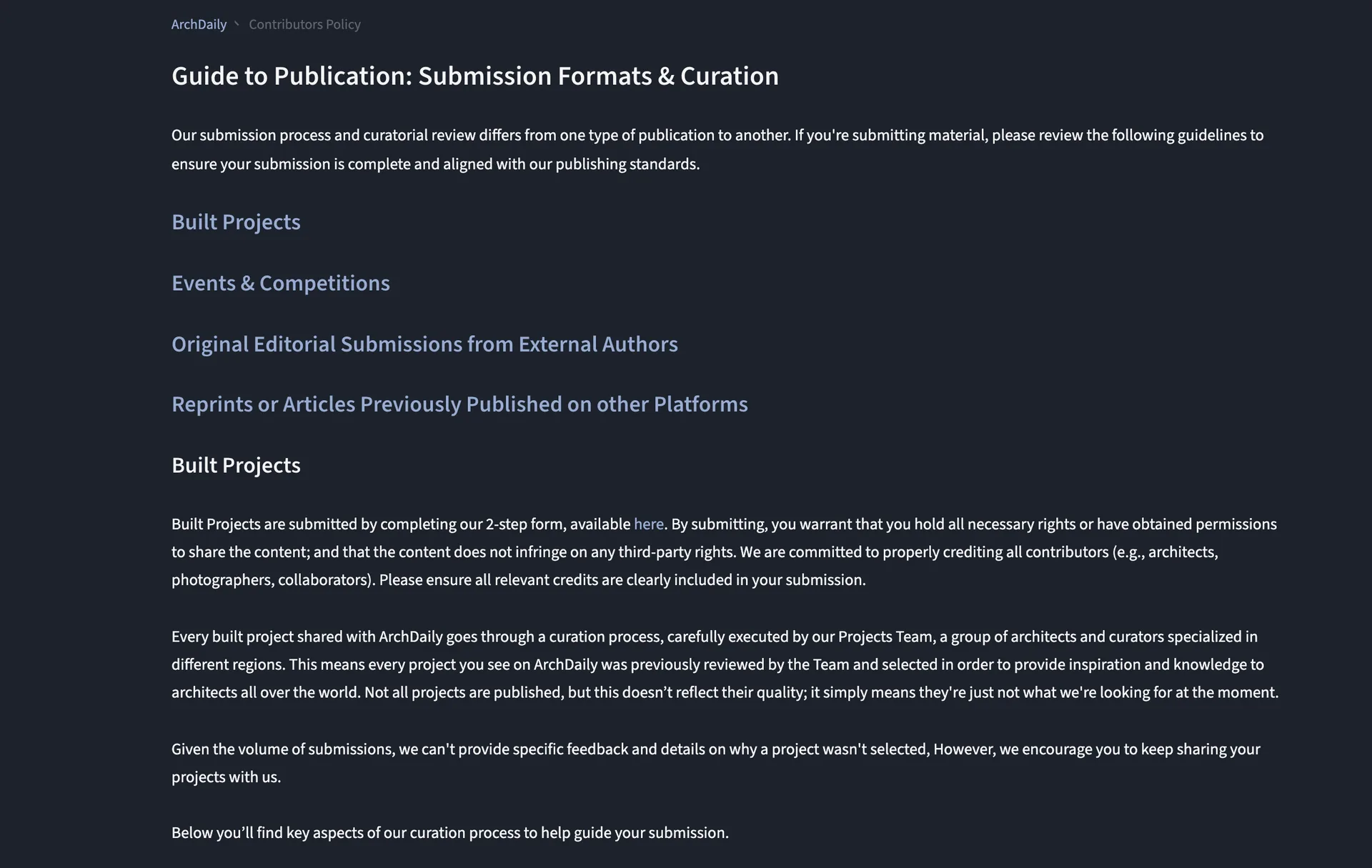
Dezeen’s notes on submitting a story say the editors strongly prefer exclusives, want JPEGs of at least 3,000 pixels on the shortest side, ask for plans and sections and expect full project credits. ArchDaily’s Guide to Publication routes built projects through a two-step form, asks you to confirm you hold the rights to every image, insists on credits for architects, photographers and collaborators, and sends each submission to a regional curation team that publishes only a selection.
Treat these rules as the brief for your own project page too. If the text, drawings, credits and high-resolution photo set are ready before the photographer’s invoice is paid, the same package goes to Dezeen, ArchDaily, regional magazines and award entries; our roadmap on how designers win awards covers the awards side. Every feature should link to the matching project page, not your home page.
Beyond editorial features, links come from people you already work with: engineers, contractors, manufacturers and universities that list projects or visiting critics. Agencies such as UppercutSEO offer link building as a managed service, and whoever does the work the principle stays the same: relevant, reputable sites mentioning your projects. Visual explainers help as well. Infographic links are a well-documented tactic, and an architect’s version is a clear section drawing or construction sequence that other sites embed with a credit.
Schema Markup for an Architecture Practice
Structured data tells Google which page describes the business and where it is. Google’s LocalBusiness structured data documentation lists name and address as the required properties and asks you to use the most specific business type available. Schema.org has no “Architect” type, so most practices use ProfessionalService, a subtype of LocalBusiness, on the home or contact page:
{
  "@context": "https://schema.org",
  "@type": "ProfessionalService",
  "name": "Studio Name Architects",
  "url": "https://www.example.com/",
  "telephone": "+44 1225 000000",
  "address": {
    "@type": "PostalAddress",
    "streetAddress": "12 Example Street",
    "addressLocality": "Bath",
    "postalCode": "BA1 1AA",
    "addressCountry": "GB"
  },
  "areaServed": ["Bath", "Bristol"],
  "sameAs": ["https://www.instagram.com/example"]
}
📐 Technical Note
Google’s LocalBusiness documentation recommends aggregateRating only for sites that collect reviews about other businesses, so marking up your own client testimonials as star ratings will not earn stars and can break the review snippet guidelines. Check every change with Google’s Rich Results Test and the Schema Markup Validator before publishing.
Keep the markup honest and in step with the visible page. Google’s search features include no result type for architectural projects, so project pages gain more from good text, captions and credits than from extra markup.
How to Measure SEO Results
Architecture enquiries are few and valuable, so rankings alone say little. Start with the Search Console Performance report, which shows clicks, impressions, click-through rate and average position. Filter it by page to see which searches each project page appears for; a project page gaining impressions at positions 8 to 20 is usually one text and image update away from page one.
Then connect search to enquiries. Track the contact form as a key event in Google Analytics, add a “how did you find us?” field, and note which page each enquiry came from. The Performance view in your Business Profile adds calls, website clicks and direction requests from Maps. Review all three monthly; SEO for architects moves in quarters, not weeks.

If you are still weighing how much search should matter next to your other online channels, our article on digital marketing as the new portfolio sets out the wider picture, and our look at architecture website benefits explains what a site should do beyond ranking.
SEO Agencies That Specialize in Architecture Firms
If nobody in the studio has the hours, an agency that already knows the sector saves the learning curve. The six below each say on their own site that they work with architecture, AEC or design firms; locations and services come from their pages, and prices appear only where the agency publishes them (checked October 2026). Most practices will shortlist one or two by market and by whether they want advice or a done-for-you service.
uClimb
uClimb is a UK SEO agency with offices on Great Portland Street in London, in Chesterfield and in Sheffield. Its architecture offer is unusually specific: a long guide to SEO for architects that covers ARB title rules and RIBA listings, plus an SEO starter package for architects designed for small studios.
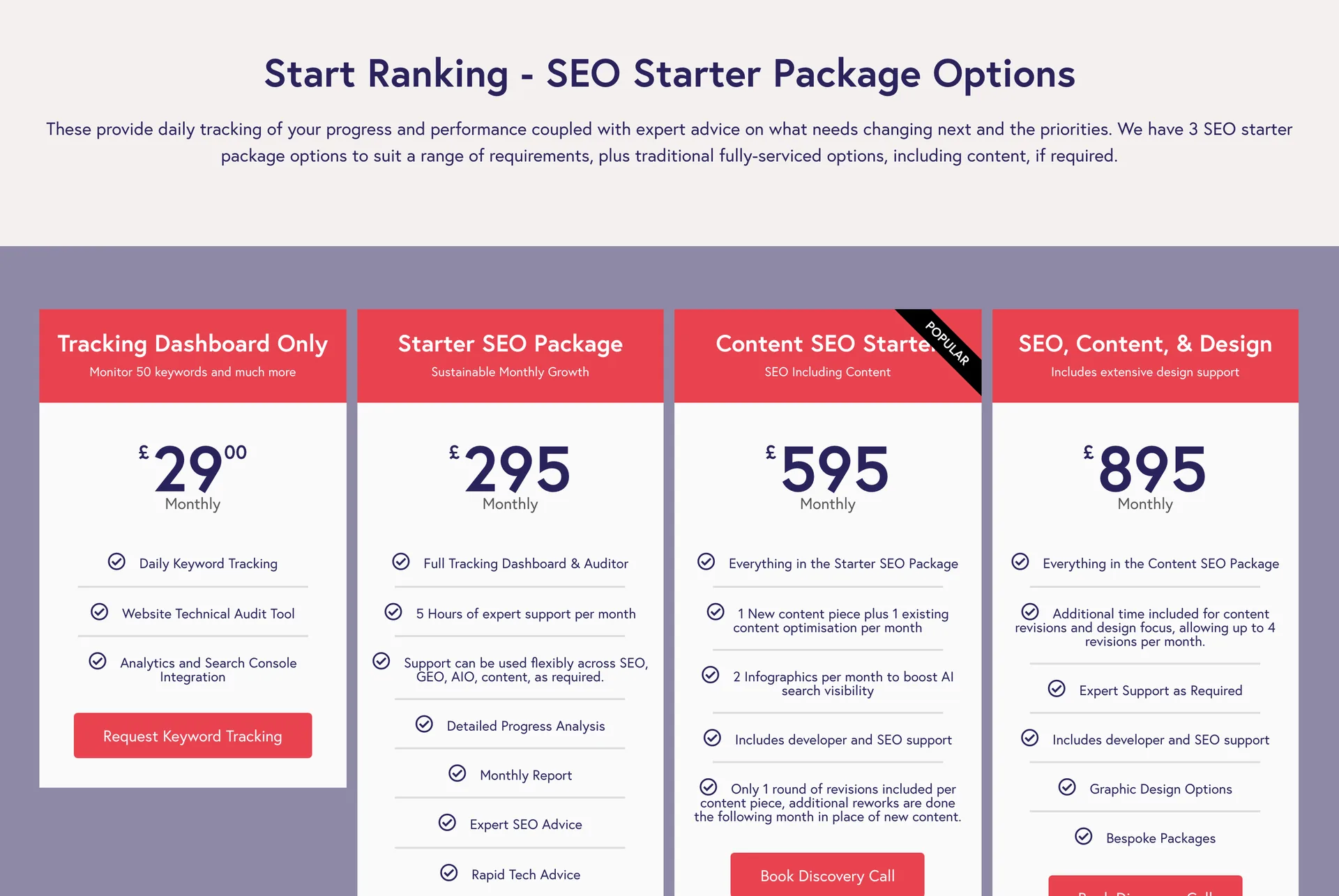
The starter model is advice plus tooling rather than a done-for-you service. As of October 2026 the price list shows a £29 monthly tracking dashboard, a £295 monthly Starter package with five hours of expert support, £595 a month with one new and one updated piece of content, and £895 a month with design support. One-off audits range from a free video review to £350 and £950 plus VAT, and a Business Profile setup costs £95 plus VAT.
Best for: small UK practices with someone in-house who can make the changes.
Watch for: on the Starter tiers your own team carries out the edits, so the advice stalls if nobody has time.
The Doers
The Doers is a London marketing collective, registered as The Doers Communications Ltd, that works with interior design studios, architecture studios and property developers. Its homes, interiors and architecture lead previously ran the UK launch of west elm, according to the agency’s page, and named clients include Nancy Gouldstone Architects and JLE Studio.
The model is a team of freelancers assembled per brief, with the client setting the budget. The page lists website development, digital PR, SEO and branding as its core experience in the sector, and work starts from a 12-month marketing plan. No prices are published.
Best for: design-led studios that want SEO tied to branding, PR and a new portfolio site.
Watch for: SEO is one channel among many here, so ask who handles the technical work and how rankings are reported.
Findable Digital Marketing
Findable Digital Marketing is a Toronto agency that calls itself a digital marketing agency for design and construction, with separate pages for architecture, interior design and construction firms. Its three-phase process runs strategy first, then search optimization for Google and AI answers, then social media, email and blog content.
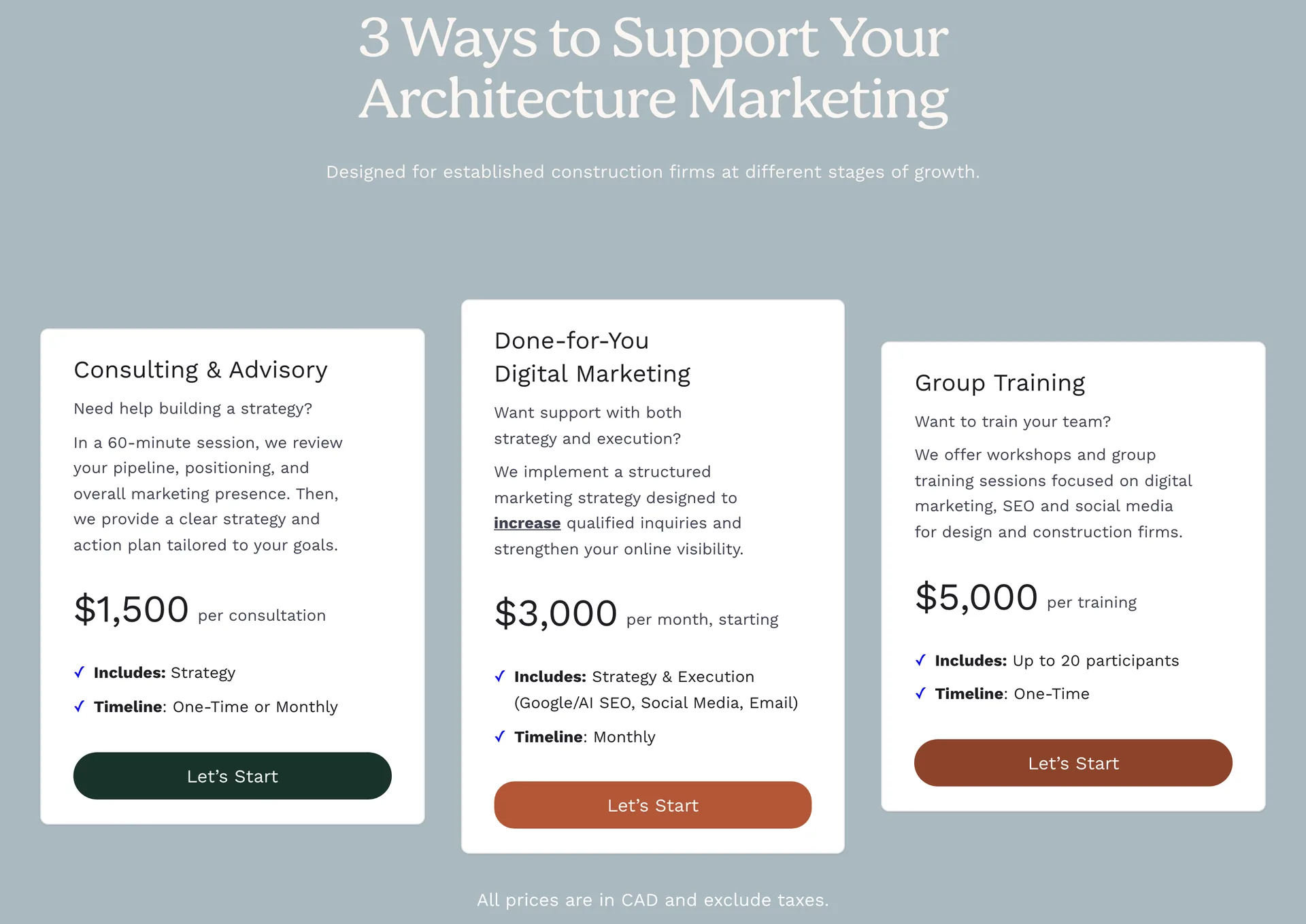
Findable publishes prices in Canadian dollars, excluding tax: CAD 1,500 for a 60-minute consultation with an action plan, done-for-you marketing from CAD 3,000 a month, and group training at CAD 5,000 for up to 20 people (as of October 2026). Its FAQ says it works across Canada and the US, does not build full websites or brand identities, and that most clients see leads within four to six months of a typical 12-month engagement.
Best for: established firms in Canada or the US that want SEO and content run for them.
Watch for: you still need a separate web developer, because Findable does not build sites.
One Firefly
One Firefly is a digital marketing agency headquartered in Coral Springs, Florida, with a dedicated page for architects and architecture firms. The agency says it has been working for nearly two decades and has been named to the Inc. 5000 list five times.
Its architecture offer covers web design, SEO, content, social media, paid advertising and branding. The SEO part lists keyword research, Business Profile and location pages, backlink building, Core Web Vitals work and case-study content. Architecture is one of several markets on its site, and its home page counts more than 1,000 technology professionals among the businesses it has marketed. It does not publish prices.
Best for: firms that want a new website and ongoing SEO from the same team.
Watch for: ask how many architecture accounts your team actually runs, since the agency’s client base is spread across other trades.
Anchour
Anchour is a full-service branding and marketing agency based in New Gloucester, Maine, with a dedicated architecture marketing practice. Its services run from brand strategy and website design to project photography, video and search engine optimization.
Anchour is one of the few agencies here to publish price ranges on its architecture page: branding projects of $30,000 to $60,000, custom websites from around $35,000, and ongoing retainers for SEO, content and paid campaigns from $5,000 a month (as of October 2026). It also says SEO and content work usually shows significant improvement within three to six months.
Best for: mid-size firms planning a rebrand and a new site with SEO built in from the start.
Watch for: the entry price is out of reach for a two-person studio that only needs local SEO.
Sixth City Marketing
Sixth City Marketing is a Cleveland, Ohio, agency, in business since 2010, with an SEO page aimed at architecture, engineering and construction firms. It says its team is entirely in-house and that it does not outsource work.
Services on that page include traditional and AI search optimization, web design, pay-per-click advertising, social media, email, CRM setup and standalone audits or consulting. Its featured construction case study is a homebuilder, M/I Homes, where it reports a 58% rise in new users year on year, and the agency also serves manufacturing and industrial clients. No prices are published.
Best for: AEC firms that want SEO and paid search under one roof, or a one-off audit.
Watch for: the case studies lean toward construction and industry, so ask for an architecture reference.
At a Glance
The table sums up where each agency is based and what it publishes:
| Agency | Base | Sector focus | Published pricing | Best for |
|---|---|---|---|---|
| uClimb | London, Chesterfield, Sheffield | Architects (starter package) | £29 to £895 a month | Small UK studios, DIY with advice |
| The Doers | London | Interiors, architecture, property | Not published | SEO with branding and PR |
| Findable Digital Marketing | Toronto | Design and construction | From CAD 3,000 a month | Done-for-you SEO and content |
| One Firefly | Coral Springs, Florida | Architects among several markets | Not published | Website plus SEO from one team |
| Anchour | New Gloucester, Maine | Architecture firms | Retainers from $5,000 a month | Rebrand, new site and SEO |
| Sixth City Marketing | Cleveland, Ohio | AEC plus industrial | Not published | SEO and PPC, or an audit |
Agency prices are as published on each agency’s website in October 2026, may exclude VAT or sales tax, and can change; confirm the current scope and fee before you sign.
Final Thoughts
✅ Key Takeaways
- Give every completed project its own URL, named for the project, building type and town, with a few hundred words of real description.
- Put photos in real
imgtags with descriptive filenames, alt text and captions; Google does not index CSS background images. - Keep the Business Profile name real, the service area within 20 places and about two hours’ drive, and never trade anything for reviews.
- Prepare one publication package (3,000-pixel photos, drawings, credits) and send exclusives first.
- Mark up the practice as ProfessionalService with name and address, and judge results by enquiries per page, not rankings.
The practices that do well in search are rarely the ones with the most pages. They are the ones whose best projects are easy to find, properly described and cited by the publications their clients already read.
Frequently Asked Questions
How long does SEO take to work for an architecture firm?
There is no fixed timeline, because it depends on competition in your area and the state of the site. Of the agencies above, Anchour says SEO and content usually show significant improvement within three to six months, and Findable says most clients see leads within four to six months. Fixing a broken Business Profile or unindexed project pages can show results sooner.
How much does an SEO agency for architects cost?
Among agencies that publish prices, uClimb charges £295 to £895 a month for its architect packages, Findable starts done-for-you marketing at CAD 3,000 a month, and Anchour’s retainers start at $5,000 a month (October 2026). Advice-only plans cost less, while full-service retainers that include content and design cost more.
Can I do SEO for my architecture practice myself?
Yes. The parts that matter most are within a studio’s control: separate project pages, properly tagged images, an accurate Business Profile and publication submissions. Google Search Console is free and shows which searches already bring you impressions, so you can see what to fix first.
Does an architecture firm need a blog for SEO?
Not before the project and service pages are in order, since those match what clients search for. Once they are, a blog can answer the questions clients ask before hiring; our guide to blogging for architects covers topics and formats.
Can I use the word “architect” in my SEO keywords?
Only if you are entitled to the title where you practise. In the UK it is protected under the Architects Act 1997, and the Architects Registration Board can prosecute misuse with fines of up to £2,500 per offence. Unregistered designers should target terms such as “architectural designer” or “building designer” instead.




Interior Design for Commercial Spaces: Enhancing Functionality and Brand Identity
Commercial interior design has to serve brand, function and regulation at once....
Begum Gumusel4 Mins read

Futuro House Production Revived in Finland After Decades-Long Hiatus
A Facebook listing for abandoned moulds led to the first new Futuro...
 illustrarch Editoral Team3 Mins read

How to Choose BIR-Compliant e-Invoicing Software: A CFO’s Evaluation Framework
Under the current Bureau of Internal Revenue (BIR) framework, the market for...
illustrarch Editoral Team5 Mins read
Building Your Dream Home in NSW: What You Should Know About Montgomery Homes
Montgomery Homes has been building across Sydney, Newcastle, the Hunter, Wollongong and...
illustrarch Editoral Team4 Mins read


Leave a comment