

Prague Architecture: How Charles Bridge and Prague Castle Built Bohemian Gothic
Charles Bridge and Prague Castle explained as architecture: the 1357 bridge under its Baroque statues, Peter Parler net vaults at St Vitus, Vladislav Hall, and how Bohemian Gothic differs from France.
 Furkan Sen4 September 20266 Mins read1
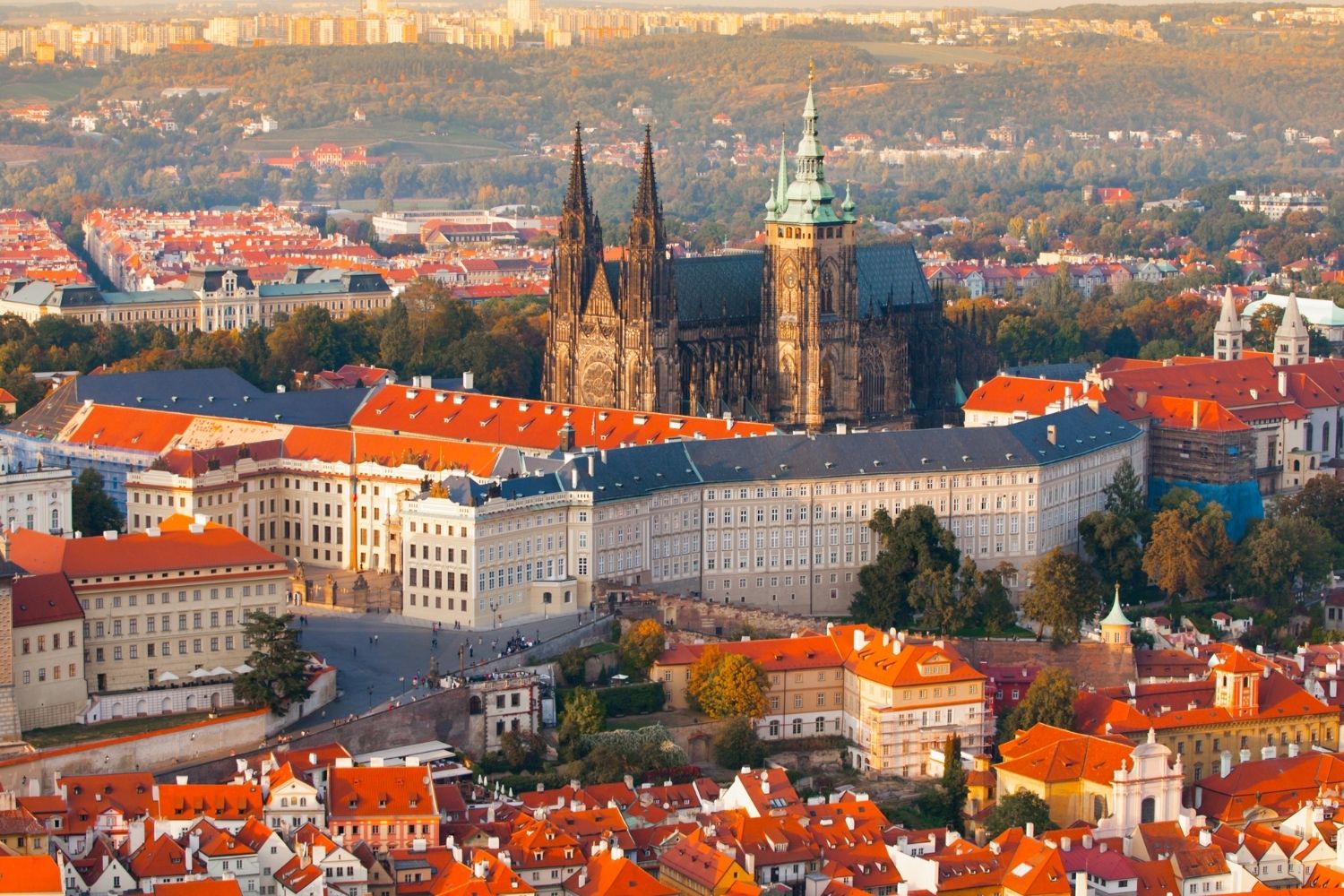
Table of Contents Show
Prague architecture is shaped above all by the building program Charles IV launched in the 14th century. St Vitus Cathedral was founded in 1344 and Charles Bridge in 1357, and both passed through the workshop of Peter Parler, whose net vaults and structural experiments pulled Bohemian Gothic away from its French models.
Most visitors read the two landmarks as scenery. Read as buildings, they record a specific political decision: a Bohemian king who became Holy Roman Emperor wanted a capital that could stand next to Paris, and he imported a French master to design it. What happened after that master died in 1352 is the more interesting part of the story, and it is still visible overhead in the cathedral choir. For the wider sweep this sits inside, our history of architecture timeline places the Gothic period against what came before and after.
Why Did Charles IV Rebuild Prague in Stone?

In 1344 Prague was raised from a bishopric to an archbishopric. A city with its own archbishop needed a cathedral to match, and the Romanesque basilica standing on the castle hill did not qualify. Charles, then heir to the Bohemian throne, brought Matthias of Arras from the papal court at Avignon to design a replacement in the French manner.
The second trigger was a disaster. A Vltava flood in 1342 wrecked the Romanesque Judith Bridge, cutting the two halves of the city apart. According to Prague City Tourism, construction of the replacement began in 1357 under Charles IV and finished in 1402. By then Charles had been crowned Holy Roman Emperor, founded the New Town in 1348, and set out to make Prague an imperial capital rather than a regional seat.
That ambition is why the historic core survives as a single readable fabric. The Historic Centre of Prague was inscribed on the UNESCO World Heritage List in 1992 as property 616, and UNESCO’s assessment credits the Gothic work of the 14th and 15th centuries with influencing building across Central Europe.
Charles Bridge: Gothic Engineering Under a Baroque Surface
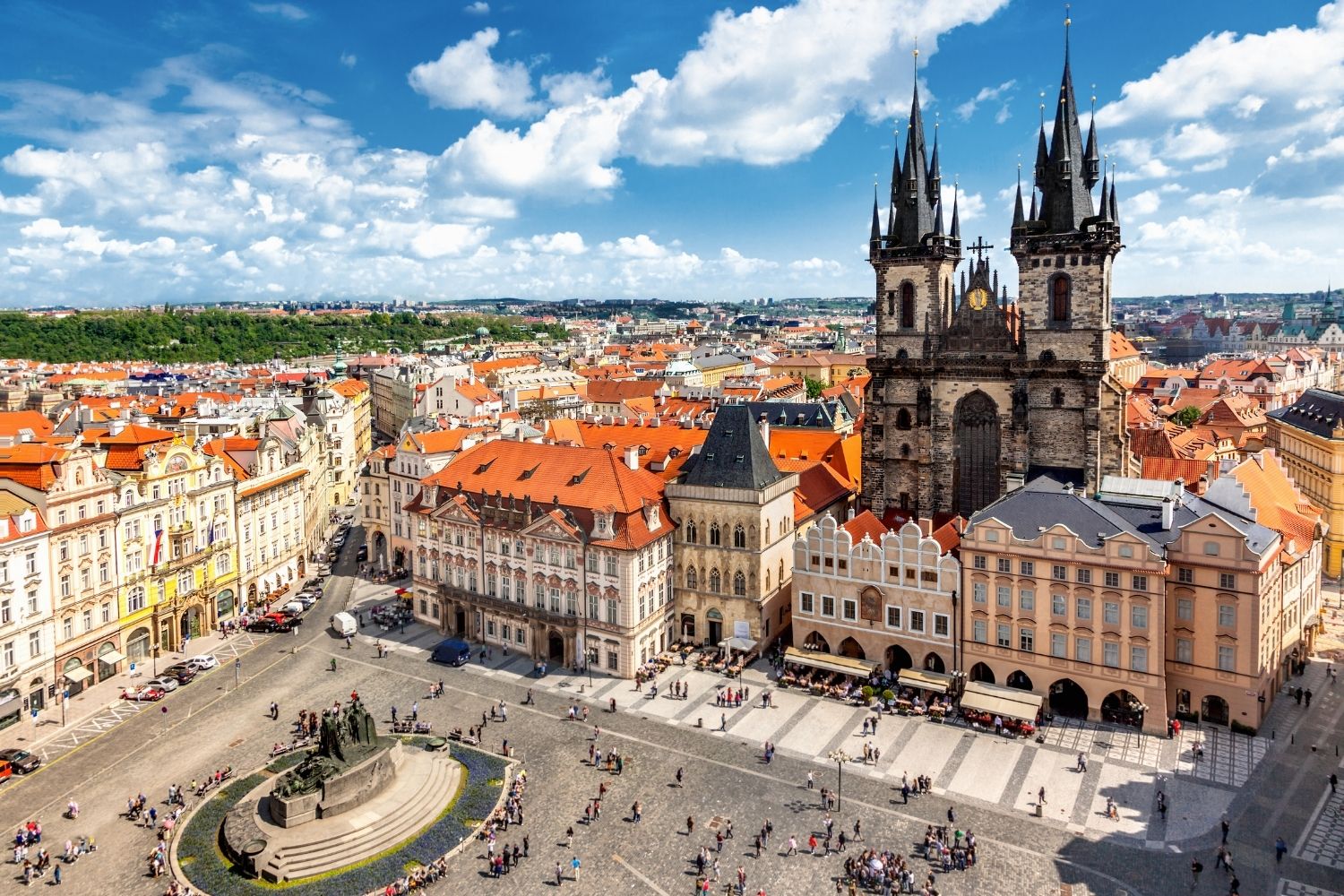
Charles Bridge is really two projects stacked on top of each other. Below the deck sits a medieval structure. Above it sits an 18th century sculpture gallery that most photographs treat as the main event.
Charles Bridge History Begins With a Flood
The bridge was designed to be unbreakable in a way the Judith Bridge was not. It runs 515.76 metres between the Old Town and the Lesser Town, carried on 16 sandstone arches whose vault spans range from 16.62 to 23.38 metres, with a deck roughly 13 metres above normal water level and a width of 9.5 metres, wide enough for four carriages abreast. It was the only crossing of the Vltava in Prague until 1841, which explains the fortified towers at both ends. Those towers were not decorative. They let the city close the river.
📐 Technical Note
The arch spans of Charles Bridge are deliberately unequal, running from 16.62 to 23.38 metres according to Prague City Tourism, because the piers were placed to suit the riverbed rather than an ideal geometry. The pier heads are cut to a point against the current and fitted with ice guards, a detail that carried the structure through the severe floods of 1432 and 1890.
The Charles Bridge Statues Are Not Medieval
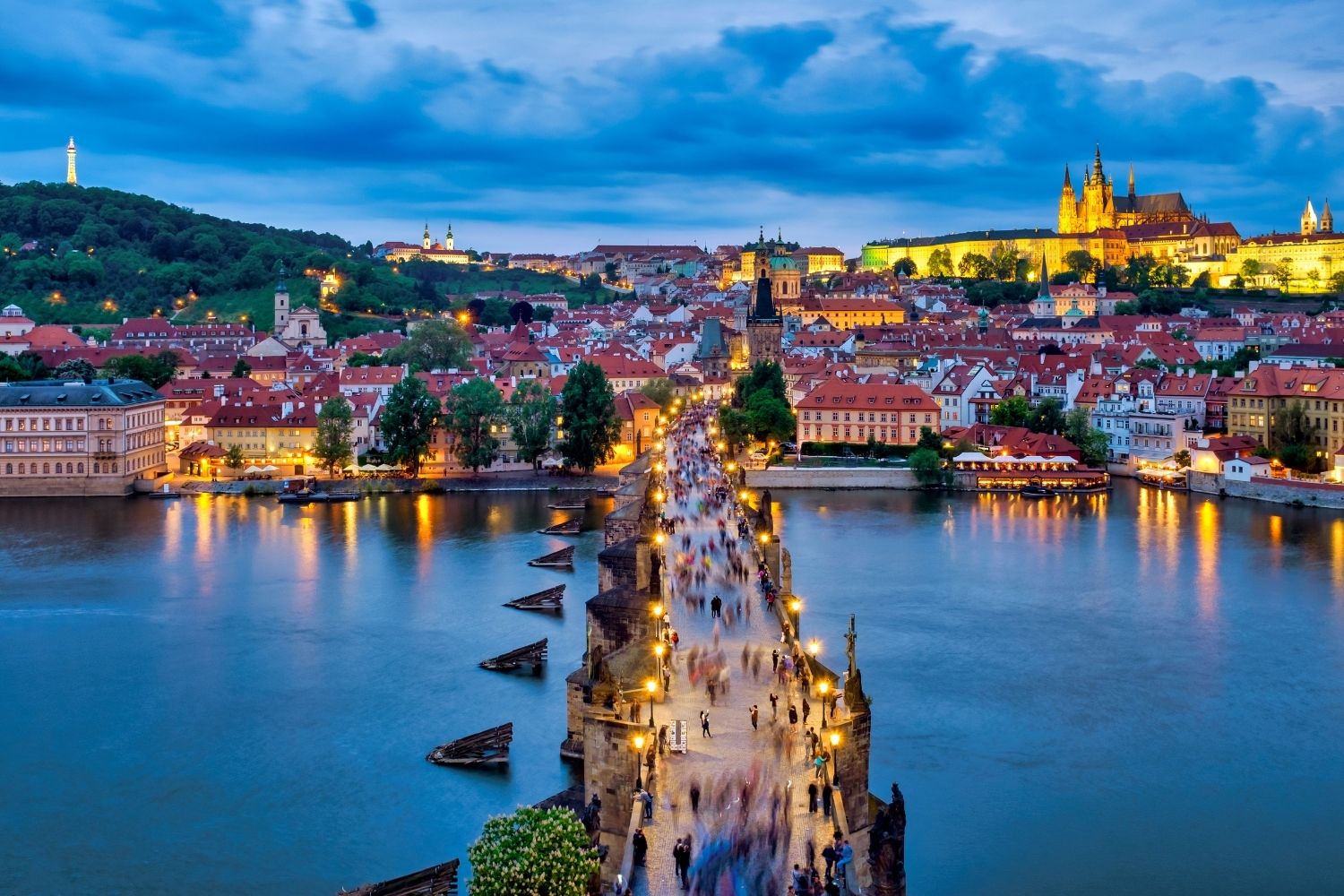
The Charles Bridge statues arrived roughly three centuries after the arches. The first of them, the bronze St John of Nepomuk cast in 1683 from a model by Jan Brokoff, set the pattern, and the alley of about 30 saints filled out through the following decades. This is a Baroque Catholic program laid over a Gothic frame, part of the visual campaign that followed the Thirty Years’ War. Most of the figures on the parapets today are copies, with the weathered originals moved into museum collections.
Separating the two layers changes how the bridge reads. The Gothic work is the deck, the arches and the towers. The Baroque work is everything you photograph.
Prague Castle Architecture: One Site, Six Centuries
Guinness World Records lists Prague Castle as the largest ancient castle complex in the world, at close to 70,000 square metres, running about 570 metres in length. It is less a castle than a walled quarter, and almost every European style since the 10th century has left something inside the walls.
St Vitus Cathedral and the First Net Vaults in Continental Europe
Matthias of Arras laid out St Vitus Cathedral as an import: a three-aisled basilica with flying buttresses, a short transept and a polygonal apse with ambulatory and radiating chapels, drawn from the southern French cathedrals he knew. He died in 1352 having built only the eastern parts of the choir. The commission passed to Peter Parler, a 23-year-old from Schwäbisch Gmünd, and the building changed character.
Parler covered the choir with what are now called net vaults. Instead of ribs meeting bay by bay, paired diagonal ribs span the full width of the choir bay and cross, producing a continuous zigzag along the length of the space and a stiffer vault. Britannica describes these as the first real net vaults on the European continent, apparently influenced by English late Gothic practice. Parler also had portrait busts of himself, Matthias, Charles IV and the royal family placed in the triforium gallery, an unusual claim to authorship in a period when master masons generally stayed anonymous.
The cathedral was not finished in the Gothic era. Work stopped with the Hussite Wars and resumed only in the 19th century, with the building consecrated in 1929. The official Prague Castle site documents the sequence, from the rotunda founded by Prince Wenceslas around 925 to the present structure. If you want the French benchmark for comparison, our article on Chartres Cathedral covers the system Parler was reacting against, and our wider survey of Gothic cathedrals sets both in context.
Vladislav Hall Closes the Gothic Chapter
The last great Gothic room at the castle is secular. Benedikt Ried built Vladislav Hall in the Old Royal Palace between 1492 and 1502, and its curving ribs no longer pretend to be structural in the medieval sense. They spiral across the ceiling as pure geometry while the windows below carry Renaissance detailing, which makes the room a hinge between two periods rather than an example of either.
🏗️ Real-World Example
Vladislav Hall, Old Royal Palace (Prague, 1492 to 1502): Prague City Tourism records the hall at 62 by 16 by 13 metres, the largest secular space in medieval Prague, with windows over 5 metres high in both the south and north walls. It was built for assemblies, banquets, markets and mounted tournaments, which is why riders could enter directly up the Riders’ Staircase. Czech presidents are still sworn in under Ried’s vault.
Gothic Architecture Prague Style Compared With the French Model
Bohemian Gothic is not a diluted version of the French original. It starts from the French plan and then changes the rules governing the ceiling, the authorship and the pace of the work. The table below sets the two side by side.
Bohemian Gothic and French High Gothic at a Glance
| Feature | French High Gothic | Bohemian Gothic under Parler |
|---|---|---|
| Vault geometry | Rib vault closed bay by bay | Net vault with paired crossing diagonals |
| Interior rhythm | Repeated units marching down the nave | Continuous zigzag along the choir |
| Authorship | Master masons mostly unnamed | Portrait busts of the architects in the triforium |
| Main building phase | Roughly 1140 to 1300 | Founded 1344, consecrated 1929 |
| Secular work | Cathedrals and civic halls kept separate | Bridge, palace hall and cathedral by one circle |
| Export route | France to England, Spain, the Rhineland | Parler family workshops across Central Europe |
The comparison also cuts the other way. The pointed arch that both traditions depend on has a long history outside Europe, a thread our piece on Islamic and Gothic architecture follows in detail, and the same structural logic reappears in Notre Dame in Paris in a different form.
Where Else Bohemian Gothic Survives in the City
Two landmarks do not exhaust Prague architecture. The Old Town Bridge Tower at the eastern end of Charles Bridge is Parler’s own work and probably the sharpest single piece of 14th century design in the city, sculpture program included. The Church of Our Lady before Týn gives you the same period in a parish setting, and the Powder Tower, begun in 1475, shows what late Bohemian Gothic did with a city gate once defence stopped being the point.
Walking east to west, the layers become obvious: Gothic bones, Baroque surfaces, then Frank Gehry’s Dancing House of 1996 dropped into a riverfront gap, a building we cover in our article on deconstructivist architecture. Prague also earns its place in our roundup of cities worth travelling for architecture precisely because those layers sit within a twenty minute walk of each other.
The most useful way to look at either landmark is to ask what each generation added and what it left alone. Charles IV’s builders set the structure, the Baroque added the saints, the 19th century finished the cathedral its founder never saw, and the 20th century inaugurated presidents under a vault built for jousting. Prague architecture holds together not because it was preserved intact but because every period since 1344 chose to keep working with what the last one left standing.








Sultan Ahmed Blue Mosque: Ottoman Architecture’s Six Minarets
Six minarets made the Sultan Ahmed Mosque famous and controversial, but the...
 Elif Ayse Sen9 Mins read
Mimar Sinan and the Suleymaniye Mosque: Inside an Ottoman Masterpiece
Mimar Sinan built the Suleymaniye Mosque between 1550 and 1557 and called...
Furkan Sen7 Mins read
Futuristic Buildings as Museums: When Architecture Becomes the First Exhibit
Six museums where the architecture arrives before the collection, from the Guggenheim...
Furkan Sen6 Mins read
Famous Train Stations: The Railway Cathedrals That Shaped Their Cities
The great termini earned the railway cathedral nickname for structural reasons as...
Furkan Sen7 Mins read




Leave a comment