

Top 10 Architecture in the USA: Ranked by Revenue, Awards, and Specialty
A ranked breakdown of the top architecture firms in the USA covering the largest firms by revenue, best residential practices, leading sustainable design studios, and top-rated workplaces for architects, with 2025 Architectural Record data and AIA award history.
 Furkan Sen31 May 202615 Mins read618

Table of Contents Show
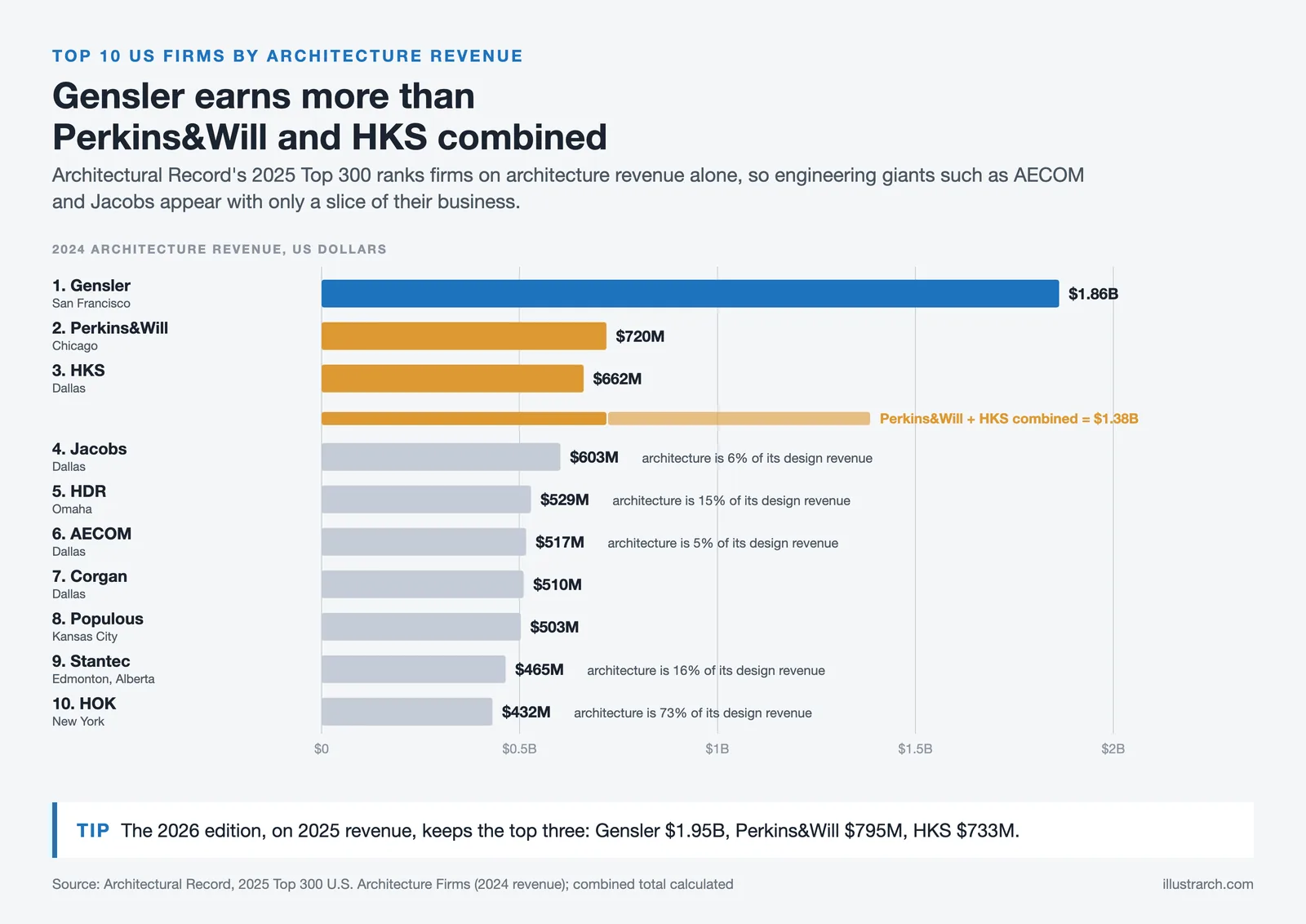
The top architecture firms in the USA are ranked annually by Architectural Record based on architecture-specific revenue. Gensler leads the 2025 list with $1.86 billion in reported revenue, followed by Perkins&Will at $720 million and HKS at $662 million. These firms, along with dozens of specialized practices, define the American built environment across commercial, residential, healthcare, and cultural sectors.
The United States is home to more than 19,000 architecture firms registered with the American Institute of Architects (AIA), ranging from sole practitioners to global enterprises with thousands of employees. Choosing the right firm for a project or career move requires more than name recognition. Revenue, design philosophy, sector expertise, workplace culture, and sustainability commitment all factor into the decision. This guide breaks down the biggest architecture firms in the USA by revenue, highlights the best residential architecture firms in the USA, profiles the best sustainable architecture firms in the USA, and identifies the best architecture firms to work for in the USA based on employee satisfaction and professional development opportunities.
Biggest Architecture Firms in the USA Ranked by Revenue

Architectural Record publishes its Top 300 U.S. Architecture Firms list each year, ranking practices strictly by architecture revenue reported for the previous calendar year. The 2025 edition, based on 2024 performance data, confirms that the upper ranks of U.S. architecture remain remarkably stable. Gensler and Perkins&Will have held the top two positions for six consecutive years.
Below is a summary of the top 10 architecture firms in the USA based on Architectural Record’s 2025 Top 300 (2024 revenue). The 2026 edition, covering 2025 revenue, keeps the same top three: Gensler at $1.95 billion, Perkins&Will at $795 million and HKS at $733 million.
Top 10 Architecture Firms in the USA by Revenue
| Rank | Firm | Headquarters | 2024 Architecture Revenue | Key Sectors |
|---|---|---|---|---|
| 1 | Gensler | San Francisco, CA | $1.86 billion | Commercial, workplace, mixed-use |
| 2 | Perkins&Will | Chicago, IL | $720 million | Education, healthcare, science |
| 3 | HKS | Dallas, TX | $662 million | Healthcare, sports, hospitality |
| 4 | Jacobs | Dallas, TX | $603 million | Infrastructure, government, science |
| 5 | HDR | Omaha, NE | $529 million | Healthcare, transportation, water |
| 6 | AECOM | Dallas, TX | $517 million | Infrastructure, government, commercial |
| 7 | Corgan | Dallas, TX | $510 million | Aviation, data centers, education |
| 8 | Populous | Kansas City, MO | $503 million | Sports, entertainment, convention |
| 9 | Stantec | Edmonton, AB (US offices nationwide) | $465 million | Community development, water, energy |
| 10 | HOK | St. Louis, MO | $432 million | Workplace, aviation, healthcare |
Revenue rankings tell an important part of the story, but they favor firms with large commercial portfolios and multi-office operations. Firms like Skidmore, Owings & Merrill (SOM), Kohn Pedersen Fox (KPF), and Diller Scofidio + Renfro may not always crack the top 10 by revenue, yet their influence on American architecture and urbanism is enormous. SOM designed One World Trade Center in New York, while KPF has shaped skylines across the globe from its base in Manhattan.
💡 Pro Tip
When evaluating the largest architecture firms in the USA for a project, look beyond total revenue. Fee income per architect is a stronger indicator of project quality and design focus. A firm with $200 million in revenue and 300 architects may deliver more attention per project than a $1 billion firm with 6,000 staff spread across dozens of offices.
If you want a broader global perspective on firm rankings, our guide to the largest architecture firms in the world covers the WA100 and Architectural Record data in detail.
Famous Architecture Firms in the USA and Their Legacy
Revenue rankings capture scale, but influence often comes from design innovation. Several famous architecture firms in the USA have shaped global design thinking while maintaining relatively smaller operations compared to corporate giants like Gensler or AECOM.
Skidmore, Owings & Merrill (SOM), founded in 1936, pioneered the glass curtain wall skyscraper and remains one of the most recognized names in the profession. Their portfolio includes the Burj Khalifa in Dubai, the John Hancock Center, and One World Trade Center. Foster + Partners, though headquartered in London, maintains a strong U.S. presence and has shaped projects like the Apple Park campus in Cupertino.
Frank Gehry’s office in Los Angeles continues to produce buildings that challenge conventional geometry. The Guggenheim Museum Bilbao, Walt Disney Concert Hall, and the Fondation Louis Vuitton in Paris are among his most recognized works. On a very different register, Tod Williams Billie Tsien Architects, a past AIA Firm Award recipient, is celebrated for buildings that prioritize craft, materials, and quiet spatial experiences, such as the Barnes Foundation in Philadelphia.
Diller Scofidio + Renfro, based in New York, has built a reputation for projects that blur architecture, art, and public infrastructure. The High Line, the Broad Museum in Los Angeles, and the expansion of the Museum of Modern Art are all DS+R projects that reshaped how Americans think about public space.
🎓 Expert Insight
“The architect’s role is not to design a building. It is to design a future.”
Bjarke Ingels, Founder of BIG (Bjarke Ingels Group)
Ingels, who runs offices in New York and Copenhagen, has become one of the most influential architects practicing in the USA. His firm’s projects, including VIA 57 West in Manhattan and the Amager Bakke waste-to-energy plant in Copenhagen, embody a design approach that merges environmental performance with unexpected form.
The AIA Architecture Firm Award, the profession’s highest firm honor, provides another lens on influence. The 2025 recipient was LPA Design Studios, and the 2026 award went to Duvall Decker, a Mississippi-based firm recognized for using architecture as a tool for social change and community advocacy. Past recipients include Bohlin Cywinski Jackson, Lake|Flato, and Olson Kundig, all firms known for exceptional residential and institutional work rather than pure scale.
Best Sustainable Architecture Firms in the USA

Sustainability has moved from a niche specialization to a baseline expectation across American architecture practice. The AIA 2030 Commitment, which asks firms to share energy performance data and work toward carbon-neutral design, has been adopted by hundreds of practices. Still, some firms stand out for the depth and consistency of their environmental work.
Perkins&Will has integrated sustainability into every stage of its design process. The firm employs nontoxic material specifications across all projects and has pledged to eliminate embodied carbon from every commercial interior it designs by 2030. Multiple projects have earned AIA COTE (Committee on the Environment) Top Ten Awards, the profession’s highest recognition for sustainable design excellence.
Gensler employs more than 1,200 LEED-certified professionals, making it one of the largest pools of green building expertise in the country. In 2020, Gensler became the first firm to win three COTE Top Ten Awards in a single year, a record that demonstrated how even the biggest corporate practices can lead on environmental performance.
Smaller firms often push sustainability further. Miller Hull Partnership, based in Seattle, designed the Bullitt Center, a six-story office building widely described as the greenest commercial building in the world. The Bullitt Center achieved full Living Building Challenge certification, one of the most demanding green building standards in existence. Miller Hull earned the top spot on Architect Magazine’s Architect 50 sustainability ranking.
Other firms recognized among the best sustainable architecture firms in the USA include BNIM in Kansas City (11 COTE Top Ten Awards and a fully certified Living Building), Lake|Flato in San Antonio (multiple COTE awards and Living Building Challenge projects), Payette in Boston (75% of projects LEED-certified since 2010 and five COTE Top Ten Awards), and ZGF Architects in Portland (designer of California’s largest net-zero facility of its kind).
📌 Did You Know?
The Bullitt Center in Seattle generates more energy than it consumes through a rooftop solar array and uses a rainwater-to-drinking-water system. It was one of the first commercial buildings in the world to achieve full Living Building Challenge certification when it opened in 2013, meeting all seven performance areas (Place, Water, Energy, Health, Materials, Equity, and Beauty).
For a broader look at sustainable architecture trends and principles, our dedicated guide covers materials, energy strategies, and case studies in depth. You can also read about green architecture for a sustainable future on illustrarch.
Best Residential Architecture Firms in the USA
Residential design in the USA spans everything from custom single-family homes to large multifamily developments. The best residential architecture firms in the USA tend to be smaller, design-driven practices that prioritize craft, site sensitivity, and close client collaboration.
Olson Kundig, based in Seattle, is one of the most awarded residential firms in the country. Founded by Jim Olson in 1966 and now led by a partnership that includes Tom Kundig, the firm is known for houses that respond intensely to landscape. Their projects frequently feature operable walls, raw steel, and exposed structural elements that blur the line between interior and exterior space. Olson Kundig received the AIA Firm Award in 2009.
Lake|Flato Architects in San Antonio approaches residential design through a regional lens. Their houses use passive cooling strategies, local stone, and deep porches suited to the Texas climate. The firm has won multiple AIA national awards and is also one of the best sustainable architecture firms in the USA, frequently integrating rainwater harvesting and photovoltaic systems into single-family projects.
On the East Coast, Robert A.M. Stern Architects (RAMSA) occupies a distinct position. RAMSA specializes in traditional and classical residential design and has designed some of the most expensive residential towers in Manhattan, including 15 Central Park West and 220 Central Park South. For clients seeking a contemporary counterpoint, Steven Holl Architects in New York is known for projects driven by light, material, and phenomenological experience.
Other notable residential practices include Bohlin Cywinski Jackson (known for the original Apple Stores and rugged mountain houses), Faulkner Architects in Truckee, California (site-specific mountain homes with stark minimalism), and Brooks + Scarpa in Los Angeles (affordable housing and art-driven residential work that has earned over 55 major design awards, including 16 AIA Honor Awards).
💡 Pro Tip
When hiring a residential architect, ask to visit a completed project in person rather than relying only on portfolio photographs. The quality of construction detailing, how natural light moves through the space at different times of day, and how well the house has aged after a few years of occupancy are things photographs rarely capture.
Best Architecture Firms to Work For in the USA

Workplace culture matters as much as design talent for architects building a career. According to AIA Firm Survey data, firms with 50 or more employees are significantly more likely to have formal diversity and inclusion programs (90% of large firms versus 37% of small firms) and equal pay policies (72% of large firms versus 23% of small firms). However, firm size alone does not determine workplace quality.
CannonDesign was named the number one Best Workplace for Innovators in the U.S. by Fast Company in 2024. The firm’s “Living-Centered Design” philosophy extends to how it treats its own staff, with mentoring programs, flexible schedules, and a strong emphasis on cross-disciplinary collaboration.
Gensler has appeared on Forbes’ list of America’s Best Large Employers in both 2024 and 2025. As an employee-owned firm, Gensler offers profit-sharing and career paths across more than 50 offices worldwide. Its scale means young architects can move between sectors (workplace, retail, sports, aviation) without leaving the firm.
Perkins&Will has earned praise for mentoring emerging professionals, offering free architectural services to nonprofits through its social responsibility program, and maintaining one of the strongest research culture of any large U.S. firm. HDR, an employee-owned firm with 11,000 staff, ranks among the world’s top design firms and is recognized for its collaboration-driven culture, particularly in healthcare design.
Smaller firms often offer different advantages. Practices like Olson Kundig, Miller Hull, and Lake|Flato are known for studio cultures where young architects work directly with principals and get hands-on construction experience early in their careers. Many firms now offer remote work flexibility and mentoring or leadership training as retention strategies.
⚠️ Common Mistake to Avoid
Many job seekers focus only on a firm’s most published projects when evaluating it as an employer. A firm might produce award-winning buildings but still have high turnover, poor compensation, or limited growth opportunities. Check AIA compensation benchmarks, ask about billable hour expectations during interviews, and look at how long mid-career staff have stayed at the firm before accepting an offer.

For more guidance on entering the profession, our article on tips for applying to architecture firms covers portfolio preparation, interview strategy, and how to evaluate firm culture.
What Sets the Top Architecture Firms Apart?
Certain qualities separate the top architecture firms in the USA from the rest of the profession. These factors apply whether a firm has 10 employees or 6,000.
Sector specialization is one clear differentiator. HKS has built a dominant position in healthcare and sports architecture by investing decades in research, post-occupancy evaluation, and evidence-based design. Populous focuses almost exclusively on sports and entertainment venues, which allows it to accumulate expertise that generalist firms cannot match. HOK excels in aviation and healthcare, while Corgan has become a leader in data center and aviation design.
A research-driven culture also sets leaders apart. Perkins&Will operates in-house research labs that study everything from healthy materials to workplace behavior. Payette in Boston embeds a Building Science Group directly into its design teams, using real-time energy modeling to inform decisions from the earliest sketch. Gensler publishes annual research reports on workplace, retail, and city trends that influence how clients think about the built environment.
Technology adoption matters increasingly. Firms that have invested early in Building Information Modeling (BIM), computational design, parametric tools, and AI-assisted rendering gain efficiency advantages that translate into better outcomes for clients. A 2023 study referenced by the AIA found that firms using integrated project management and financial tools reduced project overruns by 25%. You can read more about the software powering today’s architecture firms on illustrarch.
🔢 Quick Numbers
- Gensler reported $1.86 billion in architecture revenue for 2024, the highest of any U.S. firm (Architectural Record Top 300, 2025)
- Architectural services employment in the U.S. stood at 204,100 as of mid-2025 (U.S. Bureau of Labor Statistics, 2025)
- The U.S. construction market exceeds $2 trillion annually, with architecture firms serving as lead designers on a significant share (AIA/Deltek, 2025)

How to Choose the Right Architecture Firm for Your Project

Selecting an architecture firm requires matching your project’s needs with a firm’s strengths. The following considerations apply to both private clients and institutional decision-makers.
Start with project type alignment. A firm that excels at corporate office towers may not be the right choice for a single-family home or a school. Look at the firm’s completed project portfolio and ask specifically about work similar to yours in scope, budget, and building type. The Architizer list of 100 best architecture firms in the United States provides a useful starting point for identifying firms by design quality rather than revenue alone.
Evaluate geographic experience. Building codes, climate conditions, zoning requirements, and contractor relationships vary by region. A firm based in Phoenix with decades of desert construction experience will approach a desert home differently than a firm flying in from New York. For location-specific options, our guides to architecture firms in Austin and other U.S. cities provide detailed local profiles.
Ask about project delivery method. Some firms operate on a traditional design-bid-build model, while others prefer design-build, integrated project delivery (IPD), or construction management at risk. Your project’s budget and timeline will influence which approach makes sense. Firms experienced in IPD, for example, tend to produce fewer change orders and tighter cost control.
Finally, consider fee structure and transparency. Most architecture firms charge between 5% and 15% of total construction cost for full services, but the exact percentage depends on project complexity, firm size, and scope of services. Some firms offer fixed fees, while others bill hourly. Request a detailed scope of services document before signing any contract, and confirm what is included in each design phase.
🏗️ Real-World Example
Nashville International Airport, BNA Vision (Nashville, TN, ongoing): Corgan is leading the design for this $1.4 billion terminal expansion, one of the largest aviation projects in the southeastern United States. The project demonstrates how a firm’s deep sector specialization in aviation design translates into winning and executing major public commissions.
The Future of Architecture Practice in the USA
The American architecture industry is in a period of adjustment. According to the AIA/Deltek Architecture Billings Index, billings at U.S. architecture firms have declined in the majority of months since late 2022, with the index remaining below 50 for 31 out of 34 months through mid-2025. Clients have been cautious about starting new projects amid economic uncertainty, rising construction costs, and shifting government spending priorities.
Despite this near-term softness, several structural trends will shape which firms thrive in the years ahead. Sustainability requirements continue to tighten. State-level building performance standards, like California’s Title 24, are pushing firms to design for aggressive energy efficiency targets from day one. Federal incentives from the Inflation Reduction Act are accelerating investment in clean energy infrastructure, which benefits firms with renewable energy and electrification expertise.
Mergers and acquisitions are reshaping the landscape. According to AIA survey data, 48% of firm leaders expect architecture-to-architecture firm mergers to be the most common type of M&A activity over the next three to five years. Larger firms are acquiring specialized practices to expand sector expertise or geographic reach, while some mid-size firms are merging to achieve the scale needed to compete for larger commissions.
Technology and AI are changing how architects work. Computational design tools, AI-assisted rendering, and automated documentation are reducing the time needed for routine tasks and allowing architects to spend more time on design quality and client engagement. Firms that have invested in these tools report higher productivity and fewer project overruns. Our article on the world’s largest architectural firms examines how global practices are adapting their operations to remain competitive.
For professionals considering where to direct their careers, the data suggests that firms with strong sustainability credentials, technology adoption, and sector specialization are best positioned for long-term growth, even in a challenging billing environment.
✅ Key Takeaways
- Gensler, Perkins&Will, and HKS lead the top architecture firms in the USA by revenue, with Gensler holding the number one position for six consecutive years at $1.86 billion.
- The best sustainable architecture firms in the USA include Perkins&Will, Miller Hull, BNIM, Lake|Flato, and Payette, all recognized for COTE Top Ten Awards and Living Building Challenge work.
- For residential design, look to specialized practices like Olson Kundig, Lake|Flato, and Bohlin Cywinski Jackson rather than the largest corporate firms.
- Workplace culture varies significantly by firm size. Large firms offer broader career paths and formal development programs, while smaller firms provide direct access to principals and hands-on construction experience.
- When choosing a firm for a project, prioritize sector expertise, geographic experience, and a clear fee structure over name recognition or revenue rank alone.
Final Thoughts

The top architecture firms in the USA represent a wide range of sizes, specializations, and design philosophies. Whether you are looking for the biggest firm to handle a corporate campus, a celebrated residential practice for a custom home, a sustainability leader for a net-zero building, or the best workplace to build your career, the American architecture landscape offers options at every scale. Use revenue rankings as a starting point, but dig into portfolios, award histories, and employee reviews before making any decision. The right firm is the one whose expertise, values, and working style match your specific goals.
Note: Revenue figures and rankings referenced in this article are based on the Architectural Record Top 300 (2025 edition) and the AIA/Deltek Architecture Billings Index. Rankings can shift year to year as firms grow, merge, or refocus their practices. Always verify current data with the original sources before making business or career decisions.
Frequently Asked Questions
What is the largest architecture firm in the USA?
Gensler is the largest architecture firm in the USA by revenue, reporting $1.86 billion in architecture-specific revenue for 2024 according to the Architectural Record Top 300 list. The firm employs over 6,000 professionals across more than 50 offices worldwide and works in sectors including workplace, retail, hospitality, and urban planning.
How do I find the best architecture firm for a residential project?
Look for firms that specialize in residential design and have completed projects similar to yours in scale and style. Review their portfolio for completed houses, not just renderings. Ask for client references and visit a built project if possible. Firms like Olson Kundig, Lake|Flato, and Faulkner Architects are highly regarded for custom residential work, while larger firms like RAMSA handle high-end urban residential towers.
Which architecture firms in the USA are known for sustainable design?
Firms recognized for leadership in sustainable design include Perkins&Will, Miller Hull Partnership, BNIM, Lake|Flato, Payette, ZGF Architects, and Gensler. These firms have earned multiple AIA COTE Top Ten Awards and produced projects certified under the LEED and Living Building Challenge rating systems.
How much do architecture firms charge in the USA?
Most architecture firms charge between 5% and 15% of total construction cost for full design services, though fees vary based on project complexity, firm size, location, and scope. Some firms offer fixed fees or hourly billing. Always request a detailed scope of services proposal before signing a contract so you understand exactly what each design phase includes.
What should I look for when choosing an architecture firm to work for?
Evaluate compensation benchmarks using AIA data, check whether the firm offers mentoring, flexible work arrangements, and professional development support. Ask about career progression, billable hour expectations, and staff retention rates during interviews. Firms like CannonDesign, Gensler, and Perkins&Will regularly appear on best-workplace lists, but many smaller studios offer exceptional culture and hands-on learning.
- best architecture firms in the usa
- best architecture firms to work for in the usa
- best residential architecture firms in the usa
- best sustainable architecture firms in the usa
- biggest architecture firms in the usa
- famous architecture firms in the usa
- largest architecture firms in the usa
- top 10 architecture firms in the usa
- top architecture firms in the usa








Interior Design for Commercial Spaces: Enhancing Functionality and Brand Identity
Commercial interior design has to serve brand, function and regulation at once....
 Begum Gumusel4 Mins read

Futuro House Production Revived in Finland After Decades-Long Hiatus
A Facebook listing for abandoned moulds led to the first new Futuro...
 illustrarch Editoral Team3 Mins read

Building Your Dream Home in NSW: What You Should Know About Montgomery Homes
Montgomery Homes has been building across Sydney, Newcastle, the Hunter, Wollongong and...
illustrarch Editoral Team4 Mins read

Designing a Home Theater: Where Drapery Fits Into the Plan
In a media room the curtains are a performance layer, not decoration....
illustrarch Editoral Team3 Mins read


Leave a comment