

What Is Expressionist Architecture? Forms, Figures, and Iconic Buildings
Expressionist architecture treated buildings as emotional and sculptural objects in early 20th century Germany and the Netherlands. Its forms, key figures and surviving landmarks.
 illustrarch Editorial Team19 November 20267 Mins read1
Table of Contents Show
Expressionist architecture is an early 20th century movement, centered in Germany and the Netherlands, that treated buildings as emotional and sculptural artworks rather than rational machines. Architects like Erich Mendelsohn pushed concrete and brick into distorted, organic forms, prioritizing inner feeling and symbolic power over functional clarity.



For a few intense years after the First World War, a group of German architects rejected the cool logic that would later define the Bauhaus and reached instead for drama, distortion, and raw emotion. Expressionist architecture turned facades into faces, towers into sculptures, and brick into something almost geological. This guide explains what expressionist architecture is, where it came from, the forms and figures that defined it, and the iconic buildings that still carry its energy a century later.
What Is Expressionist Architecture?
Expressionist architecture is a design movement that flourished in Europe roughly between 1910 and 1930, defined by the distortion of form for emotional effect and the treatment of architecture as fine art. According to Wikipedia’s survey of the movement, it subordinated realism to symbolic expression, favored biomorphic and crystalline shapes, and drew on Gothic and Romanesque feeling rather than classical order.
The movement grew out of the broader Expressionist current in German painting, poetry, and theater, where artists like Wassily Kandinsky prized raw inner experience over accurate description. Translated into building, that meant facades that lean, curve, fracture, and seem to move. Where most modern architecture asked how a building should work, expressionism asked how a building should make you feel. It is one of the more emotionally charged chapters in the broader story of architectural styles, sitting between Art Nouveau and the rationalist modernism that soon eclipsed it.
📌 Did You Know?
Many of the wildest expressionist visions were never built. Between 1919 and 1920 Bruno Taut organized the “Glass Chain,” a secret exchange of utopian letters and sketches among architects who dreamed of crystalline glass cities and alpine glass monuments. Most of these radical schemes existed only on paper, yet they shaped the imagination of an entire generation.
Where Did Expressionism in Architecture Come From?
Expressionism in architecture emerged from the social and emotional upheaval of early 20th century Germany, intensifying in the years surrounding the First World War. The collapse of the old imperial order, the trauma of the war, and the brief idealism of the Weimar Republic created an appetite for buildings that expressed renewal, spirituality, and even revolution rather than imperial confidence.
Two forces fed the movement. The first was the painterly Expressionism already alive in groups like Die Brücke and Der Blaue Reiter, which celebrated distorted color and form as carriers of feeling. The second was technical: reinforced concrete, steel, and mass-produced brick made shapes possible that earlier masonry could never achieve. Architects seized these materials not to build efficiently, but to sculpt. This experimental spirit connects expressionism to the wider evolution of modern architecture from Bauhaus to Brutalism, where each generation reinterpreted what raw structure could say.
🎓 Expert Insight
“The architect’s most important task is the creation of beauty… He must be a master of form, a sculptor in the noblest sense.”, Erich Mendelsohn, architect of the Einstein Tower
Mendelsohn’s view captures the expressionist position precisely. The building is not a neutral container but a sculptural statement, and the architect is first an artist shaping emotion through mass and line.
Key Characteristics of Expressionist Architecture
Expressionist buildings rarely share a single look, because individual emotion was the point. Still, several recurring traits let you recognize the style across very different structures.
Distorted and Sculptural Forms
The most obvious marker is the deliberate distortion of form. Walls curve and bulge, corners sharpen into prows, and roofs rise like waves. The aim is movement and tension, a sense that the building is alive rather than static.
Organic and Crystalline Inspiration
Many architects looked to nature for their vocabulary. Some pursued organic forms drawn from caves, plants, and the human body, while others, especially the glass visionaries, chased crystalline geometries of faceted, jewel-like surfaces. Both rejected the rectangle as the default unit of design.
Brick Expressionism
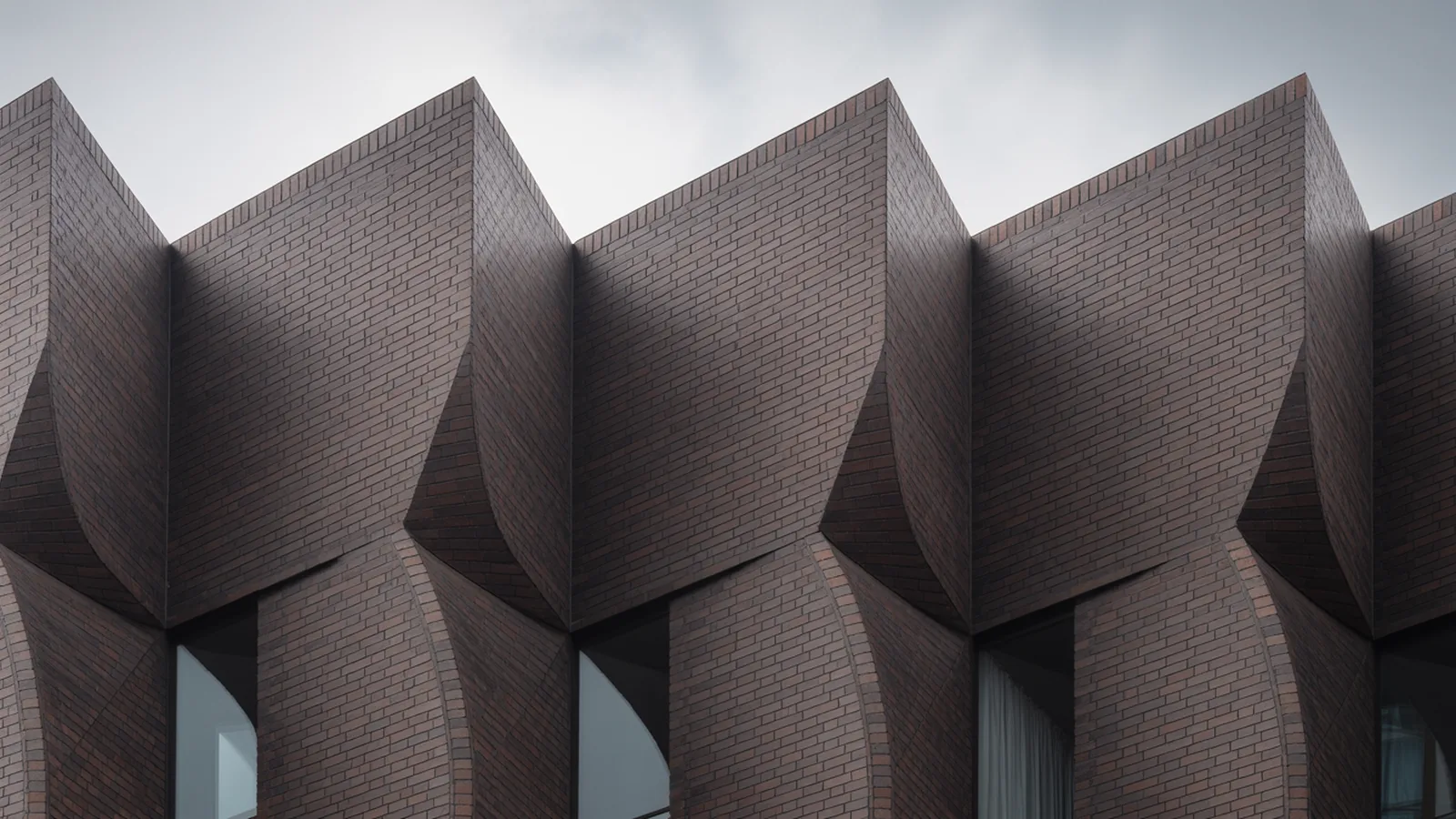
In northern Germany and the Ruhr, a distinct variant called brick expressionism used dark clinker brick, tile, and patterned masonry as the primary visible material. Architects exploited the texture, color, and shadow of brick to create rich, almost woven surfaces, proving that emotional architecture did not require concrete to make its point.
Architecture as Emotion and Symbol
Above all, expressionist work carried symbolic intent. A tower might embody scientific revolution, a theater might dramatize a “people’s stage,” and a glass pavilion might preach spiritual renewal. Function mattered, but meaning mattered more.
🏗️ Real-World Example
Chilehaus (Hamburg, 1924): Fritz Höger’s office block is the defining work of brick expressionism. Its dramatic eastern corner narrows to a knife-edge prow resembling a ship’s bow, built from roughly 4.8 million dark clinker bricks. Now a UNESCO World Heritage Site, it shows how ordinary material became pure sculpture in expressionist hands.
Who Were the Key Figures of Expressionist Architecture?
The movement was driven by a small circle of architects, several of whom later moved toward modernism. Four figures stand out for shaping its identity.
Erich Mendelsohn
Mendelsohn is the most celebrated name in expressionist architecture, largely on the strength of the Einstein Tower. Influenced by painters like Kandinsky, he sought construction methods that allowed sculptural freedom and settled on reinforced concrete to achieve flowing, dynamic form. He later evolved toward a sleeker, more streamlined modernism in his department stores and cinemas.
Hans Poelzig
Poelzig brought theatrical imagination to the movement. His remodeling of Berlin’s Großes Schauspielhaus in 1919 filled the interior with hanging stalactite-like pendentive forms and dramatic colored light, turning a theater into a cavern of feeling. His industrial buildings and water towers showed that even utilitarian structures could carry expressionist weight.
Bruno Taut
Taut was the movement’s idealist. His Glass Pavilion at the 1914 Cologne exhibition, a faceted dome of colored glass, became a manifesto for glass architecture as a vehicle for spiritual and social transformation. Through the Glass Chain letters and books like Alpine Architecture, he pushed expressionism toward utopia.
Fritz Höger
Höger anchored the brick expressionist wing. The Chilehaus in Hamburg made him famous, demonstrating how dark clinker brick, sharp angles, and rhythmic detailing could produce a building of monumental drama without a single curve of concrete.
Iconic Expressionist Buildings
A handful of structures define the movement and remain its most studied examples.
The Einstein Tower, Potsdam
The Einstein Tower is the icon of German expressionism. Designed by Mendelsohn and built between 1921 and 1924 on the Telegrafenberg in Potsdam, it is a solar observatory conceived to study Einstein’s theory of relativity. According to ArchDaily’s classic profile of the building, Mendelsohn intended a monolithic reinforced concrete form, but the technology of the day forced builders to complete much of it in brick covered with spray plaster, preserving the seamless, sculptural surface. Its curving, eyelid-like windows and wavelike base still read as a single flowing gesture.
Großes Schauspielhaus, Berlin
Poelzig’s 1919 transformation of this Berlin theater created one of the most atmospheric interiors of the era. Hundreds of suspended pendentive forms dripped from the dome like a stalactite cave, lit to dissolve the boundary between architecture and theatrical illusion. It embodied the expressionist dream of a “people’s theater” charged with collective emotion.
Chilehaus, Hamburg
The Chilehaus remains the masterpiece of brick expressionism. Its ship-prow corner, soaring brick galleries, and intricate clinker detailing turned a commercial office building into a civic landmark and earned it UNESCO recognition as part of Hamburg’s Kontorhaus district.
How Expressionism Influenced Later Architecture
Expressionism in its pure form faded by the early 1930s, overtaken by the rational, functionalist agenda of the Bauhaus and the International Style. Yet its emotional, sculptural impulse never fully disappeared. The drive to make structure speak with feeling resurfaced in the raw, monumental forms of the post-war era, a lineage you can trace through our guide to Brutalist architecture and concrete modernism.
Echoes of expressionism appear in the sweeping concrete shells of mid-century architects, in the organic curves of late modernism, and even in today’s parametric, free-form design enabled by digital tools. The conviction that a building can be a sculpted emotional event, not just a useful box, is expressionism’s most durable legacy. To see how that idea fits within the longer arc of building history, our timeline on the history of architecture places the movement in its full context.
Frequently Asked Questions
What defines expressionist architecture?
Expressionist architecture is defined by distorted, sculptural forms designed for emotional impact, the treatment of buildings as works of art, and inspiration drawn from organic and crystalline shapes. It values symbolic meaning and inner feeling over strict function, distinguishing it from the rational modernism that followed.
When did expressionist architecture take place?
The movement was most active in Europe between roughly 1910 and 1930, peaking in Germany and the Netherlands in the years surrounding the First World War. Some historians backdate its origins to around 1905, and its influence extends beyond these years.
What is brick expressionism?
Brick expressionism is a regional variant centered in northern Germany and the Ruhr that used dark clinker brick, tile, and patterned masonry as the main visible material. Fritz Höger’s Chilehaus in Hamburg is its most famous example, showing how brick texture and color could create dramatic, sculptural surfaces.
What is the most famous expressionist building?
The Einstein Tower in Potsdam, designed by Erich Mendelsohn and completed in 1924, is the most famous example of expressionist architecture. Its flowing, sculptural form and original purpose as a solar observatory for relativity research make it the movement’s defining icon.
The Bigger Picture
Bottom Line: Expressionist architecture was a short but vivid revolt against rational design, insisting that buildings could carry emotion, symbolism, and sculptural drama. Though the movement faded within two decades, its belief that structure can move us still shapes how architects think about form today.





Doric Architecture: The Doric Order Explained
Doric architecture is the oldest of the three classical Greek orders: sturdy...
illustrarch Editorial Team8 Mins read
Pueblo Revival Architecture: Features & Examples
Pueblo revival architecture adapts Ancestral Puebloan adobe and Spanish Colonial forms into...
illustrarch Editorial Team9 Mins read
What Is Rococo Architecture? Origins, Features, and Key Buildings
Rococo architecture emerged in early 18th century France with lightness, asymmetry and...
illustrarch Editorial Team8 Mins read
What Is Vernacular Architecture? A Complete Guide to Local Building Traditions
Vernacular architecture is what gets built without architects: local materials, local climate,...
illustrarch Editorial Team9 Mins read




Leave a comment