

The Next Step in Structural Design: Combining AI, BIM, and Advanced Simulation Tools
AI, BIM, and advanced simulation tools are now integrated into a unified ecosystem that enhances accuracy, speed, and decision-making in structural design.
 Furkan Sen26 November 20255 Mins read248

Table of Contents Show
In a controlled GitHub study, developers using an AI coding assistant completed a programming task 55% faster. Artificial intelligence (AI), Building Information Modeling (BIM), and high-fidelity simulation platforms are no longer separate tools, they now form a unified ecosystem that unlocks accuracy, speed, and decision-making capabilities unavailable even a decade ago.
This article explores how these technologies converge, why their integration matters, and how modern structural analysis software like SDC Verifier helps engineers take the next step in structural analysis and code compliance.
Why does Structural Design Integration Matter?
Traditional workflows separate design modeling, simulation, documentation, and verification into distinct steps.
However, fragmentation slows down the process and increases the chance of human error.
Moving toward integrated platforms solves key issues:
- Data loss between tools (e.g., CAD → FEA → reports)
- Repetitive manual operations, like model reconstruction
- Difficult compliance checks across dozens of code editions
- Limited traceability for design decisions
A unified ecosystem powered by AI, BIM, and advanced simulation changes the game completely.
How BIM Sets the Foundation
BIM (Building Information Modeling) has evolved from 3D geometry into an intelligent database for the life cycle of a structure.
BIM lets structural engineers integrate materials, loads, documentation, and maintenance strategies into one model.

Benefits of BIM Integration for Structural Engineering
- Centralized project data shared across disciplines
- Accurate clash detection and prevention of field issues
- Linking design, simulation, and fabrication
- Better sustainability assessment through material tracking
Key standardized guidelines like ISO 19650 help ensure that BIM workflows remain consistent across global teams.
AI: The New Brain of Structural Engineering
AI isn’t replacing engineers; it accelerates and augments their expertise.
Thanks to advances in machine learning, generative design, and predictive analytics, AI tools can now identify patterns and provide engineering recommendations based on massive datasets.
Current AI Applications in Structural Engineering
| AI Capability | Engineering Benefit |
| Automated load prediction | Faster initial modeling stages |
| Generative design | Optimized geometries for weight vs. strength |
| Defect recognition | Detects stress hotspots in seconds |
| Design rule checks | Ensures compliance with standards instantly |
| Predictive maintenance models | Extends asset lifecycle |
A study by Deloitte reported that AI-driven design optimization can reduce structural weight by 10-20% while maintaining safety margins.
How Machine Learning Is Changing Structural Analysis
Machine learning (ML) in structural engineering is not one technique but a group of methods that learn patterns from data instead of solving every problem from first principles. A 2022 state-of-the-art review by H.-T. Thai in the journal Structures grouped its applications into five areas: structural analysis and design, structural health monitoring and damage detection, fire resistance of structures, the resistance of structural members under various actions, and the mechanical properties and mix design of concrete.
Surrogate Models for Faster Design Exploration
The most direct use in analysis is the surrogate model. Engineers run a set of finite element simulations, then train a neural network or another regression model to predict results such as deflection, stress or natural frequency from the input parameters. Once trained, the surrogate returns an estimate almost instantly, which makes it practical to compare thousands of design options at the concept stage. The surrogate does not replace the final FEA check. It narrows the field, so full simulations are spent on the most promising options.
Physics-Informed Neural Networks
A known weakness of purely data-driven models is that they can return answers that break basic mechanics. Physics-informed neural networks (PINNs), introduced by Raissi, Perdikaris and Karniadakis in the Journal of Computational Physics in 2019, address this by building the governing differential equations into training. For structural problems, the network is penalized when its prediction violates equilibrium or boundary conditions, which helps when training data is scarce.
Damage Detection and Structural Health Monitoring
Computer vision is the most mature ML application in practice. In 2017, Cha, Choi and Büyüköztürk showed in Computer-Aided Civil and Infrastructure Engineering that a convolutional neural network could detect concrete cracks in photographs, and similar models are now paired with drone and robotic inspections of bridges, tunnels and facades. On instrumented structures, ML models also read sensor data such as acceleration and strain to flag changes in stiffness that may point to damage.
Limits Engineers Should Keep in Mind
- Data quality: a model is only as reliable as the simulations or tests it learned from, and it can fail without warning outside that range.
- Explainability: code compliance requires traceable calculations, which a black-box prediction cannot provide on its own.
- Responsibility: the engineer of record still signs the design, so ML outputs should be verified with established FEA and code checks before they reach the drawings.
That last point is where machine learning meets the integrated workflow described below: ML speeds up exploration, while simulation and automated code checking confirm the result.
The Intersection: AI + BIM + Simulation in One Workflow
The real revolution begins when these three technologies work together.
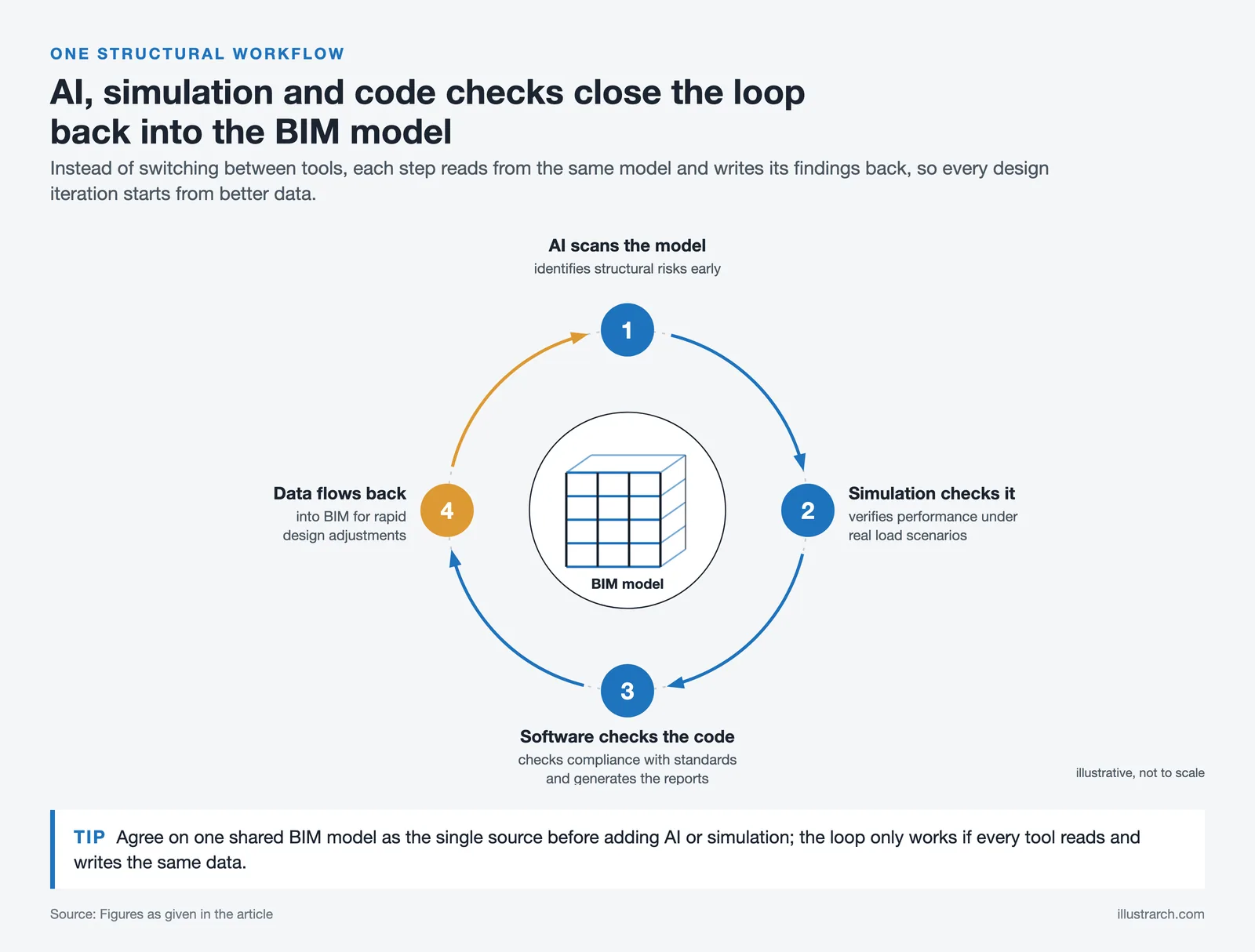
Instead of switching between tools, engineers can create a single closed-loop process.
What Integrated Workflows Achieve
- AI analyzes the BIM model and identifies structural risks early.
- Simulation tools verify performance under real load scenarios.
- Software automatically checks standards of compliance and generates reports.
- Data flows back into BIM for rapid design adjustments.
This creates a continuous improvement cycle where each design iteration becomes smarter and more robust.
Example of How Advanced Simulation Tools Help Engineers
Structural Analysis Software, SDC Verifier, is a leading example of how simulation and automated code checking can be seamlessly integrated into engineering workflows.
It bridges the gap between FEA models and design code verification, two steps that are often disconnected in traditional processes.
Key Advantages of Using SDC Verifier
- Automated design code checking (AISC, Eurocode, DNV, ABS, API and more)
- Direct integration with major FEA tools like ANSYS, Simcenter Nastran, and Femap
- Customizable engineering checks for niche industries (offshore, cranes, civil, mechanical)
- Report generation with zero manual formatting
- Loads automation, including fatigue, buckling, and stability workflows
Its automation features reduce engineering time significantly while ensuring complete traceability and compliance.
Real-World Use Cases Where Integration Matters Most
1. Offshore Structures
Platforms and wind turbines require complex load calculations influenced by wind, waves, and fatigue.
SDC Verifier helps automate checks using standards like DNV-RP-C201 and API RP 2A.
2. Shipbuilding & Maritime Engineering
New IMO and IACS rules require detailed buckling and fatigue analysis.
By linking FEA models to automated rule checking, engineers eliminate manual errors and accelerate approval.
3. Industrial Equipment (Cranes, Lifting Structures)
Weight optimization and fatigue life prediction are crucial for safety.
AI-driven predictions combined with automated simulation reduce both cost and risk.
4. Civil & High-Rise Construction
BIM-based structural workflows benefit from AI-supported reinforcement layouts and simulation-verified stability analysis.
Comparison Table
| Workflow Stage | Traditional Approach | AI + BIM + Simulation Approach |
| Modeling | Manual CAD builds | Automated BIM extraction |
| Load Definition | Estimated inputs | AI-assisted load prediction |
| Simulation | Independent tools | Fully connected workflow |
| Verification | Manual spreadsheet checks | Automated code compliance |
| Reporting | Time-consuming manual formats | Instant auto-generated reports |
| Iterations | Slow and error-prone | Rapid, data-driven optimization |
The integrated approach not only increases accuracy but improves project profitability.

Conclusion
Structural engineering is heading toward deeply interconnected workflows powered by AI reasoning, BIM-based collaboration, and simulation precision.
Software like SDC Verifier is enabling this transition by bridging simulation and compliance, giving engineers more time to focus on creativity and innovation.
As the industry continues its digital transformation, one thing is clear:
Engineers who use integrated, intelligent tools will define the next generation of safer, smarter, more sustainable structures.







Futuro House Production Revived in Finland After Decades-Long Hiatus
A Facebook listing for abandoned moulds led to the first new Futuro...
 illustrarch Editoral Team3 Mins read

Building Your Dream Home in NSW: What You Should Know About Montgomery Homes
Montgomery Homes has been building across Sydney, Newcastle, the Hunter, Wollongong and...
illustrarch Editoral Team4 Mins read

Designing a Home Theater: Where Drapery Fits Into the Plan
In a media room the curtains are a performance layer, not decoration....
illustrarch Editoral Team3 Mins read
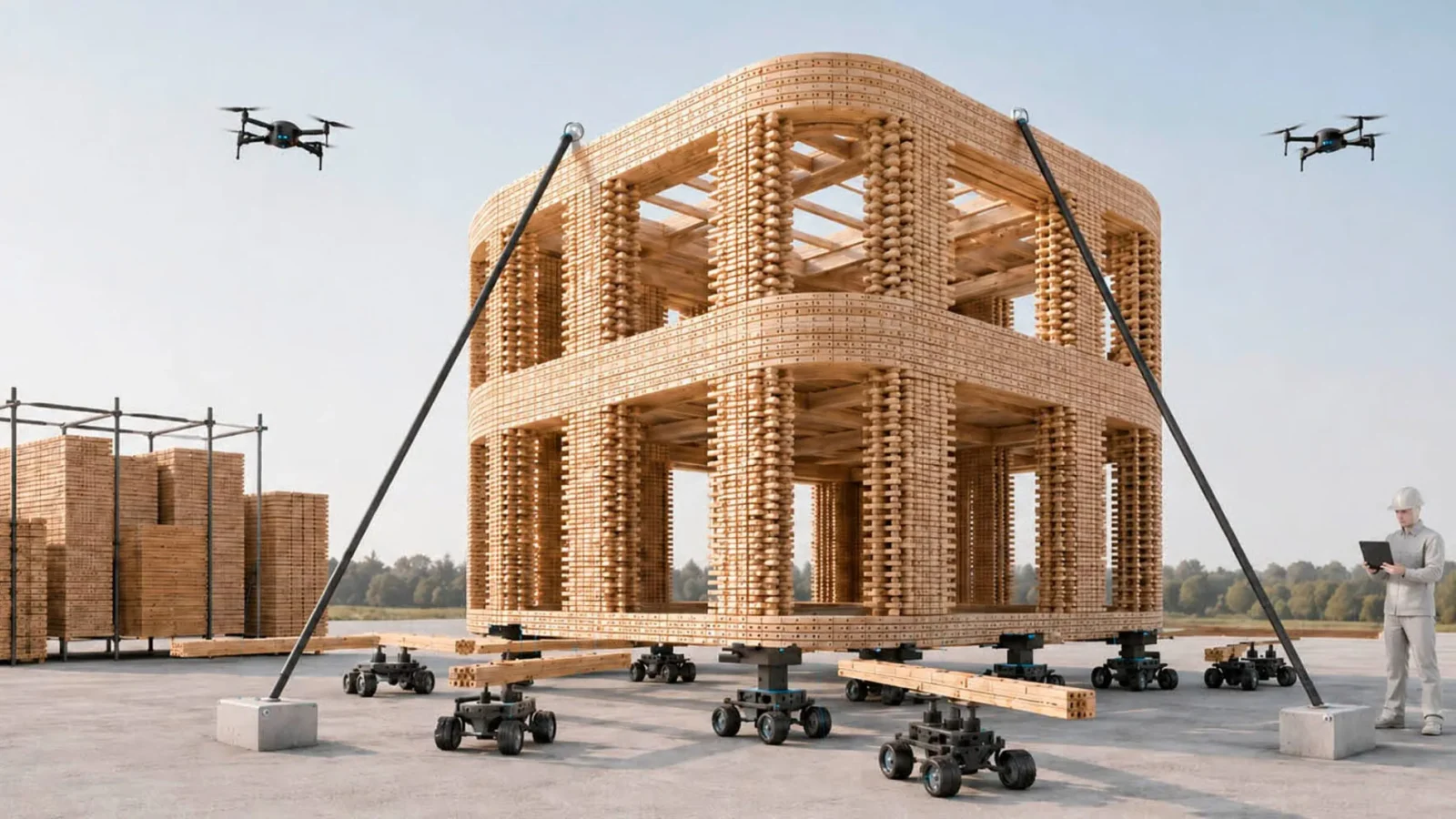
Foster + Partners to Test Robot Swarms Building Timber from the Top Down
Foster + Partners wins €4m EU grant to build robot and drone...
illustrarch Editoral Team2 Mins read


Leave a comment