

The Giant LEGO World Cup Trophy: Inside the Largest Mobile Brick Build
At Rockefeller Plaza, the LEGO Group and FIFA unveiled a 27 foot LEGO World Cup Trophy made from 1,363,402 bricks. Built in eight months by 59 specialists and shipped in 16 sections, it works like a piece of modular architecture on a public plaza.
 Elif Ayse Sen19 July 20269 Mins read300
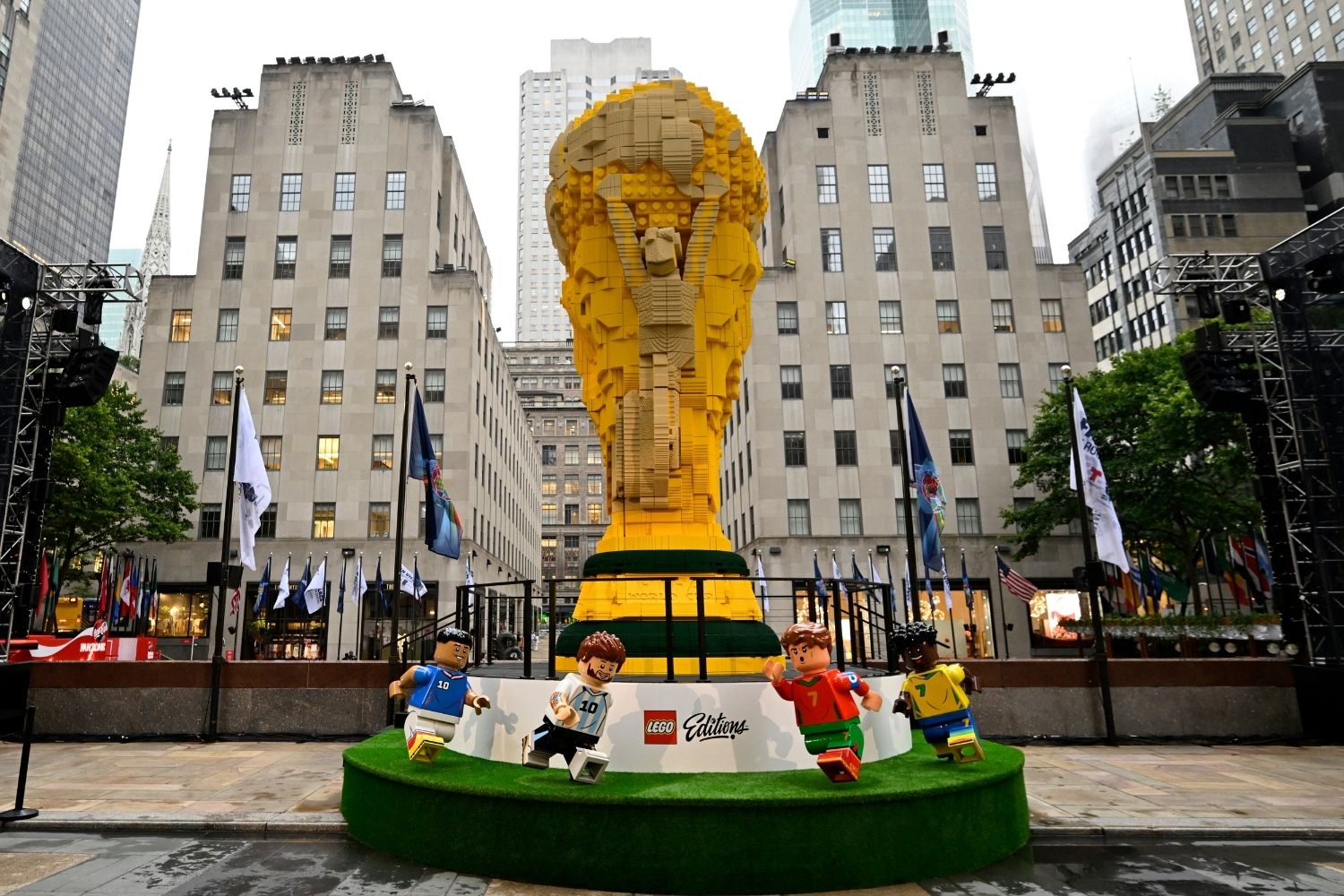
Table of Contents Show
The giant LEGO World Cup Trophy is an 8.47 meter installation at Rockefeller Plaza in New York City, built from 1,363,402 LEGO bricks. Unveiled on July 6, 2026 with football legend Cafu, it is the largest mobile LEGO build ever made and the centerpiece of the LEGO Fan Zone during the FIFA World Cup 2026 finals.
For a few weeks each summer, Rockefeller Plaza usually belongs to tourists and office workers. This July it belongs to football. As the FIFA World Cup 2026 heads into its final matches across the United States, Mexico, and Canada, the LEGO Group and FIFA have planted a golden landmark in the middle of Manhattan. The trophy stands nearly 27 feet tall, gleams like the real thing, and turns a children’s construction toy into something closer to public architecture. It sits alongside the stadium designs already drawing attention this tournament, from Atlanta to Los Angeles, a playful counterpoint to the serious engineering behind the venues hosting the World Cup.
What Is the Giant LEGO World Cup Trophy?
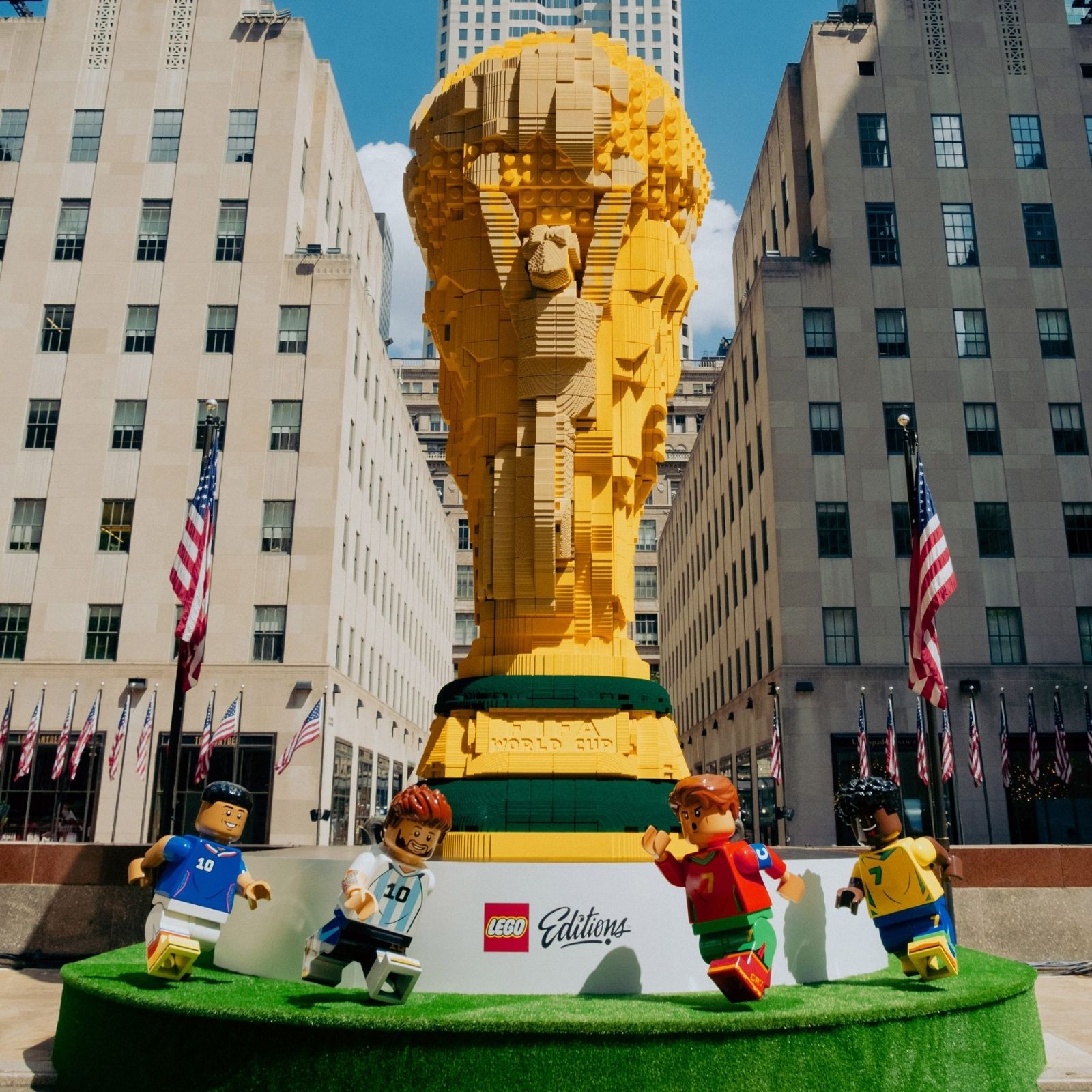
The giant LEGO World Cup Trophy is a promotional installation and public art piece that recreates football’s most recognizable prize at monumental scale, described by LEGO and design press as roughly 25 times the real trophy’s size. LEGO calls it the largest mobile build the company has ever produced, meaning it can be taken apart, transported, and reassembled rather than fixed permanently to one site. The gold surface is pure LEGO brick. The structure underneath is steel. Together they create a landmark that reads as sculpture from a distance and as engineering up close.
The real FIFA World Cup Trophy, designed by Italian sculptor Silvio Gazzaniga and awarded to every winner since 1974, stands just 36.8 centimeters tall and is cast in solid 18 carat gold. Scaling that compact object up to the height of a three story building meant the team could not simply enlarge the design. They had to rebuild its curved, organic form out of straight edged bricks, which turned out to be the hardest part of the entire project. This is the same challenge, at a different scale, that LEGO designers face whenever they translate complex real world geometry into stud based models.
Getting the proportions right mattered more than it might sound. A trophy is instantly recognizable by its silhouette, two stylized figures holding up a globe, so any distortion would have read as wrong to the millions of fans who know the shape by heart. The team studied the original closely, then worked out how to approximate its smooth transitions with rectangular parts, layering and offsetting bricks to suggest curves the pieces cannot actually form. The finished surface has to convince from across a plaza and hold up in close photographs, two very different viewing distances that pull the design in opposite directions.
A Monument Built Brick by Brick
The headline number is the one that stops people mid stride. The trophy contains exactly 1,363,402 LEGO bricks, weighing around 4.2 tonnes on their own. For scale, the recently announced LEGO Sagrada Família set, the largest LEGO set ever sold by piece count, uses 12,060 pieces. The New York trophy uses more than a hundred times that many bricks in a single object.
🔢 Quick Numbers
- 1,363,402 LEGO bricks used, weighing about 4.2 tonnes (LEGO Group newsroom, July 2026)
- 7,040 hours of model building and assembly by a team of 59 specialists (LEGO Group newsroom, July 2026)
- 8 months from concept to finished build at the Kladno facility in the Czech Republic (LEGO Group newsroom, July 2026)
- 16 major sections for transport, carried on pallets up to 230cm by 230cm (LEGO Group newsroom, July 2026)
Those figures come straight from the LEGO Group, which built the model at its Model Production facility in Kladno, Czech Republic. The same team has produced large scale display models for stores and events for years, but nothing on this footprint. According to the company’s official announcement, the build absorbed 7,040 hours over eight months, a schedule the designers admit was tight for an object this size. The team of 59 included designers, engineers, model builders, and assembly technicians, closer to a small construction crew than a toy workshop.
To put the labor in perspective, 7,040 hours is close to three and a half years of full time work for one person, compressed into eight months by a team working in parallel. Every section had to be planned, built, checked, and prepared for shipping. Unlike a normal building, where a mistake can often be patched on site, a model like this leaves little room for improvisation once the pieces are loaded onto a truck bound for the port.
How Was the Biggest LEGO Build Engineered and Transported?

The biggest LEGO build ever made had to survive an Atlantic crossing before a single visitor saw it. To make that possible, the team split the trophy into 16 major sections, each engineered to lock back together with precision once it reached Manhattan. The heaviest single section weighed close to two tonnes. The largest transport pallets measured 230 centimeters by 230 centimeters, roughly the size of a small room laid flat.
Holding everything upright is an internal steel frame weighing about 3.5 tonnes. The bricks form the visible skin while the steel does the structural work, carrying wind load and self weight the way a building’s frame would. This split between a load bearing core and a lightweight outer surface is a familiar move in construction. It is the same logic behind modular and prefab building systems, where finished components are made in a controlled factory and assembled quickly on site.
Design publication Wallpaper* described getting the model to Manhattan as an engineering exercise in its own right, with the completed trophy dismantled, shipped across the Atlantic, and rebuilt on the plaza. The precision required to make 16 separate sections align perfectly is closer to prefabricated construction than to a weekend on the living room floor.
📐 Technical Note
The trophy rests on an internal steel structure of roughly 3.5 tonnes, while the LEGO shell adds about 4.2 tonnes on top. Splitting a monument into 16 transportable sections around a steel core mirrors modular construction practice, where a rigid frame carries the loads and factory made panels form the enclosure (LEGO Group newsroom, July 2026).
When Modular Construction Meets Public Art
Strip away the fact that it is made of toy bricks, and the LEGO World Cup Trophy behaves like a temporary architectural installation. It occupies a prominent civic space. It was fabricated off site and assembled on location. It uses a structural system chosen for transport and speed. Cities around the world increasingly use exactly these kinds of short term structures to activate public squares, and the principles overlap heavily with prefabrication in architecture.
The comparison is not just poetic. The same qualities that make LEGO appealing to a child, standardized parts, predictable connections, and easy assembly, are the qualities engineers prize in modular systems. A brick from 1958 still clicks into a brick made today because the molds hold a tolerance of about two micrometers. That kind of repeatability is what lets more than 1.36 million separate pieces add up to a stable eight meter structure instead of a pile.
🎓 Expert Insight
The goal, in the words of LEGO senior designer Christophe Vietti, is “to unite people through the love of football and play.”
Vietti framed the giant trophy as a landmark for fans during the tournament’s closing stages, and has described its curved shape as the toughest element to recreate from rectangular bricks.
Design publication Dezeen noted that the installation is an enlarged, 25 to 1 version of the 1:1 LEGO World Cup trophy set the brand released earlier in 2026, tying the public spectacle directly back to a product fans can build at home. That link between a landmark people travel to see and an object they can buy is central to how the whole campaign was designed.
This pattern is becoming common. Over the past decade, cities have leaned on pavilions, pop ups, and temporary structures to bring energy to squares and waterfronts, often during festivals or major sporting events. These projects tend to be cheaper than permanent construction, faster to approve, and simple to remove once the moment passes. What they share with the trophy is a reliance on modular, prefabricated parts that can be made elsewhere and installed with minimal disruption to the space around them.
Inside the LEGO World Cup Fan Zone at Rockefeller Plaza
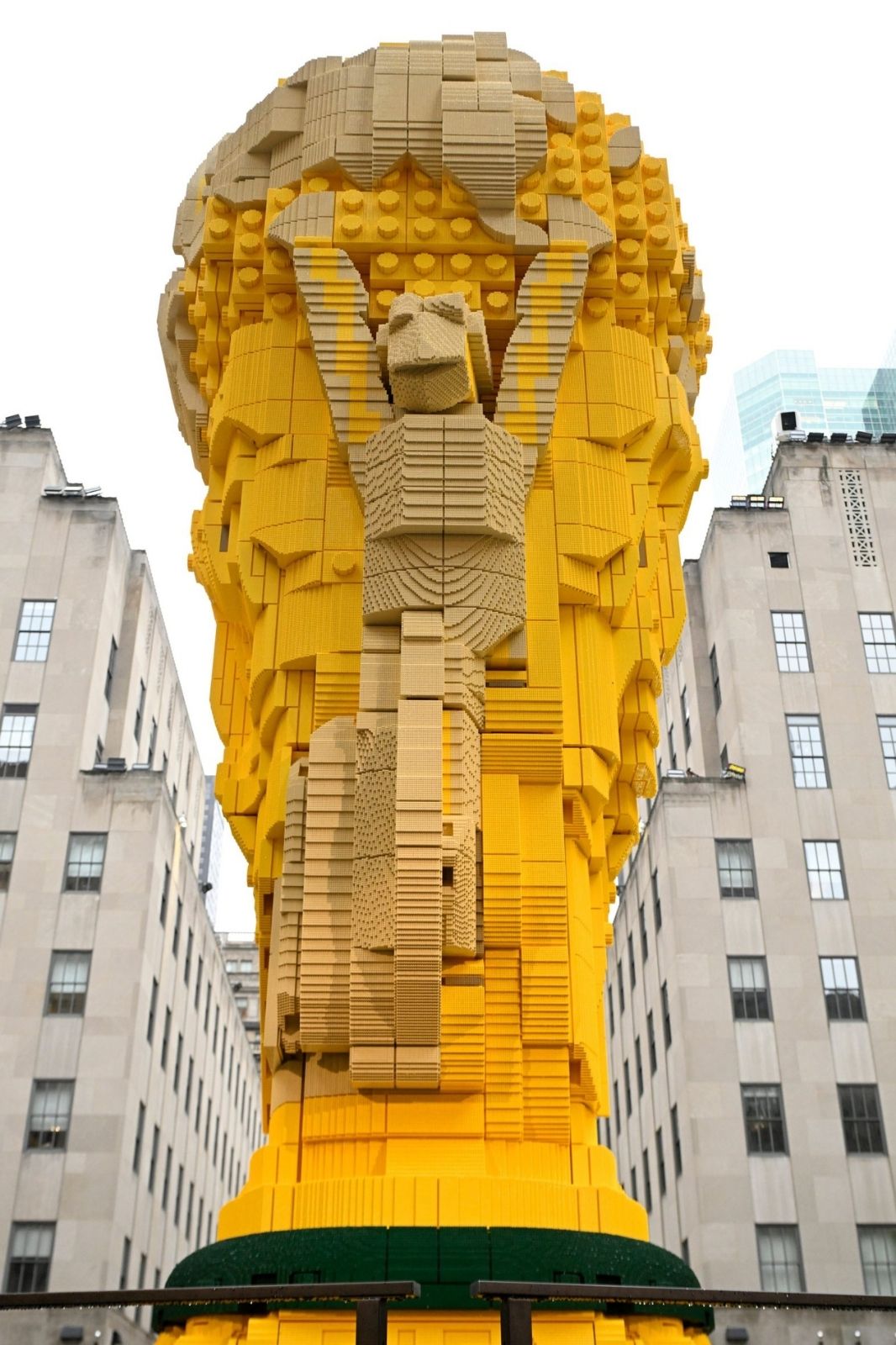
The trophy is the anchor of a larger activation called the LEGO Fan Zone, open to the public at Rockefeller Plaza from July 6 to July 19, 2026, timed to run through the FIFA World Cup 2026 final. Entry is free. Around the trophy, LEGO set up interactive building stations, a collaborative FIFA themed brick mural, personalized minifigure creation, giveaways, and photo moments aimed at families and fans of every team. A separate Champions Garden extends the experience beyond the plaza itself.
The unveiling leaned on football history. Brazilian legend Cafu, a FIFA World Cup winner, placed the final pieces alongside fans representing the nations still alive in the tournament. Cafu called the recreation “truly incredible,” praising the craftsmanship and the way the sport pulls people together across generations. The moment doubled as the opening of LEGO’s official Fan Village at Rockefeller Center, one node in a broader run of activations spanning North America, Europe, and Asia Pacific. It also builds on the LEGO Editions football line, which turned Cristiano Ronaldo, Lionel Messi, Kylian Mbappé, and Vini Jr. into minifigures for the first time.
The commercial logic sits close to the surface. LEGO released a buildable 1:1 version of the trophy earlier in the year, then built a landmark fans have to see in person, then surrounded it with free activities that keep visitors inside the LEGO world long enough to consider a purchase. It is a familiar marketing play, executed at unusual scale. For the tournament, it also gives the New York fan festival a fixed visual anchor, something every broadcast shot and phone camera keeps returning to.
How the Giant Trophy Compares to Other LEGO Builds
Piece count alone does not capture what makes this build unusual. A giant installation, a record breaking consumer set, and a 1:1 replica are three very different objects, even when they all wear the LEGO name. The table below places the New York trophy next to other notable LEGO builds and the real prize it copies.
LEGO World Cup Trophy vs Other Record LEGO Builds
The following table summarizes how the installation compares by size and purpose:
| Build | Bricks or Pieces | Approx. Height | What It Is |
|---|---|---|---|
| Giant LEGO FIFA World Cup Trophy | 1,363,402 | 8.47 m (27 ft) | Largest mobile LEGO build, public installation |
| LEGO Sagrada Família (set 21065) | 12,060 | 62 cm (24 in) | Largest LEGO set ever by piece count |
| LEGO FIFA World Cup Official Trophy (set 43020) | 2,842 | 1:1 replica scale | Buildable home version of the real trophy |
| Real FIFA World Cup Trophy | Solid 18 carat gold | 36.8 cm (14.5 in) | Awarded to every winner since 1974 |
Seen side by side, the New York installation is less a bigger toy than a different category of object. The consumer sets are designed to fit on a shelf. This one was designed to hold a public plaza, which is why it needed a steel skeleton and a shipping plan. The connection between the giant and the buyable set is deliberate, giving fans who see it in person a way to take a piece of the moment home. LEGO Architecture sets have long done something similar for buildings, turning icons like the Sydney Opera House into objects people can build and display.
Architecture at the Scale of Play

The LEGO World Cup Trophy sits in a growing category of temporary structures that do real architectural work. It frames space, draws crowds, and gives a plaza a center of gravity, all without a foundation or a permit for a permanent building. That is placemaking, the practice of turning ordinary public space into somewhere people gather, and it is increasingly done with installations rather than permanent construction.
🏗️ Real-World Example
LEGO House (Billund, 2017): Designed by Bjarke Ingels Group, this 12,000 square meter cultural building is composed of 21 stacked volumes that read like oversized LEGO bricks. It is the clearest proof that brick logic can scale from a toy into permanent, inhabitable architecture, not only a temporary spectacle.
The parallel matters because it shows a spectrum rather than a gimmick. At one end sits a permanent building shaped by brick logic, like BIG’s LEGO House. At the other sits a mobile installation shaped by the same interlocking system, like the New York trophy. Both treat standardized modules as a serious design tool. If you want to see how far that idea can go, it helps to look at how enthusiasts and architects already build full structures from LEGO style blocks.
There is also a lesson here about materials. Architects spend careers arguing over how a facade should meet the ground, how a joint should be expressed, how a familiar material can be pushed into a new role. The trophy takes the most familiar material imaginable, a plastic brick almost everyone has held, and asks it to behave like cladding on a monument. That shift, from toy to building skin, is exactly the kind of move that makes people look twice, and looking twice is half the job of any public installation.
Temporary or not, the trophy makes an argument for how cities can use design during big events. A single, striking object in the right public space can carry an entire program, from photo ops to build stations, and give hundreds of thousands of visitors a shared reference point. The engineering is what makes it possible. The play is what makes people care.
The Bigger Picture
The most surprising thing about the LEGO World Cup Trophy is not its height or its brick count. It is that a mass produced children’s toy, sold in similar boxes for decades, can become a civic landmark that stops traffic in one of the busiest plazas on earth. As permanent construction gets slower and more expensive, temporary installations like this one are quietly taking over the job of giving public space its memorable moments. The question worth watching is not how big the next brick build will be, but how much of the work of placemaking these fast, modular, deeply familiar systems will end up doing.



Ai Weiwei Installs 500 Cast-Iron Helmets Outside Sydney Museum
Ai Weiwei's 500 cast-iron helmets opened outside Sydney's MCA on 25 September,...
 illustrarch Editoral Team2 Mins read

Isamu Noguchi at Lever House Traces Sculptor’s Decades-Long Collaboration with Bunshaft
Lever House's new exhibition pairs Noguchi sculptures with unbuilt garden designs made...
illustrarch Editoral Team2 Mins read
Relocated Maya Structures at Mexico’s Balam Tun Memory Park Face Legal Challenge
INAH archaeologists have filed a complaint against 26 officials over Balam Tun...
illustrarch Editoral Team2 Mins read

Heather Roberge, UCLA Architecture Professor and Murmur Founder, Dies at 55
UCLA professor and Murmur founder Heather Roberge, a 2026 AIA LA Educator...
illustrarch Editoral Team2 Mins read


Leave a comment