

26 Best AI Architectural Rendering Tools in 2026
AI is revolutionizing architectural visualization in 2026, enabling faster iterations, richer creativity, and photorealistic results. This guide explores the top AI rendering tools shaping modern design workflows and transforming how architects create, communicate, and visualize their ideas.
 Bahattin Duran3 December 202514 Mins read497
Table of Contents Show
Quick Answer: The best AI architectural rendering tools turn sketches, models and text prompts into realistic visuals in seconds. Leading 2026 options cover fast concept rendering, photorealistic output and style exploration. They speed up visualization, cut manual rendering time and let architects test ideas early, though human refinement is still needed for accuracy.
Artificial intelligence has rapidly evolved from a futuristic concept into one of the most influential forces shaping architectural practice today. By 2026, AI-driven rendering tools have completely redefined how architects explore form, test ideas, communicate intent and deliver visual narratives. What once required hours of manual modeling, lighting setup or post-production can now be accomplished in minutes through intelligent, learning-based systems trained specifically on architectural data. Instead of relying on a small number of design iterations due to time constraints, architects can now generate dozens of alternatives effortlessly, compare them instantly and refine their creative vision with unprecedented agility. This shift has not only accelerated traditional visualization workflows but also expanded the boundaries of imagination, enabling architects to experiment with atmospheres, materials, geometries and spatial relationships that would have been difficult or impractical to develop manually.
In this landscape, AI tools are no longer simple rendering assistants—they have become integrated creative partners that support every stage of design, from early concept ideation and site analysis to high-fidelity marketing imagery and immersive client presentations. The architectural field is experiencing a democratization of visualization power, where both large studios and independent designers have access to world-class rendering capabilities. As these tools continue to evolve, their impact is fundamentally reshaping the culture, process and language of architectural production. This guide presents the most advanced AI architectural rendering tools available in 2026, offering insights into how each one enhances the modern design workflow and contributes to a more dynamic, efficient and imaginative practice.
AI Architectural Rendering Tools at a Glance
| # | Tool | Primary Use Case | Best For | Pricing (Approx.) | Platform |
|---|---|---|---|---|---|
| 1 | Archfine AI | Architecture-focused rendering | Conceptual to final-stage visualization | Credit-based plans | Web-based |
| 2 | Midjourney v7 | Conceptual ideation & moodboards | Competitions, presentations, early design | From $10/month | Discord / Web |
| 3 | Adobe Firefly | Post-production & enhancement | Refining raw renders, brand consistency | Included with Creative Cloud | Photoshop / Web |
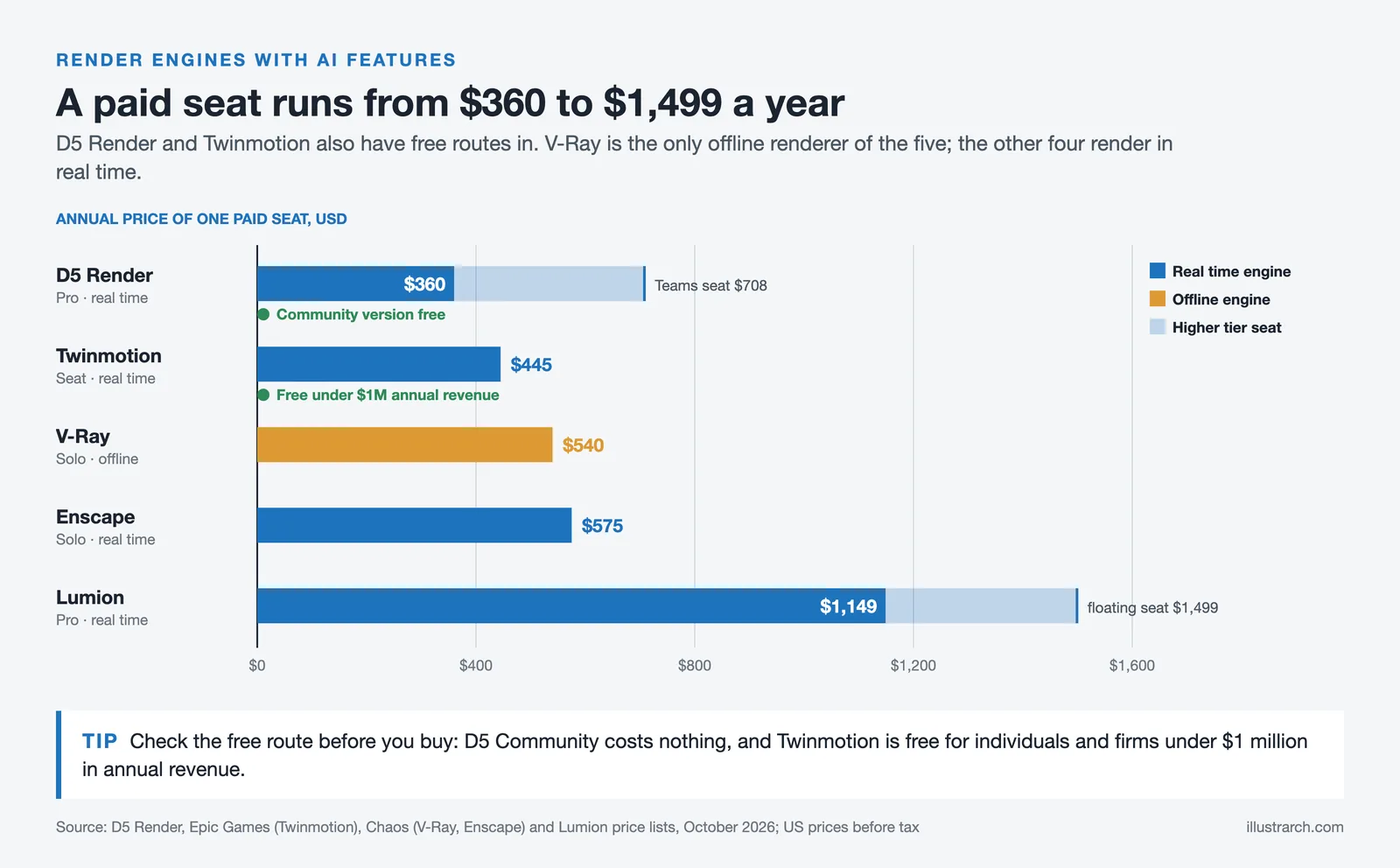
| 4 | D5 Render AI Suite | Real-time ray tracing rendering | Animations, walkthroughs, fast iteration | Free / $360/year (Pro), $708/seat/year (Teams) | Windows (Standalone) |
| 5 | Roomvana | Photo-based exterior restyling | Facade studies, renovation & curb-appeal proposals | Freemium | Web & iOS |
| 6 | Lumion 2026 AI Assist | Scene-aware rendering optimization | Atmospheric visuals, cinematic scenes | $1,149 to $1,499/year | Windows (Standalone) |
| 7 | Enscape Neural Render | Real-time BIM visualization | Iterative design, coordination meetings | From $575/year | Plugin (Revit, Rhino, SketchUp, ArchiCAD) |
| 8 | V-Ray Vision AI | High-end photorealistic rendering | Marketing imagery, competition boards | From $540/year | Plugin (3ds Max, SketchUp, Rhino, Revit) |
| 9 | Twinmotion AI | Environmental realism & animation | Landscape, urban design, masterplans | Free under $1M revenue / $445/year | Windows / Mac (Standalone) |
| 10 | Autodesk Forma | Environmental analysis & visualization | Urban projects, sustainability, feasibility | Custom / Enterprise | Cloud-based |
| 11 | Blender AI Add-ons | Hybrid AI-enhanced visualization | Advanced customized rendering pipelines | Free (Open Source) | Windows / Mac / Linux |
| 12 | Kaedim AI | 2D to 3D model conversion | Early massing, form-finding, competitions | Subscription-based | Web-based |
| 13 | Sloyd.AI | Procedural parametric generation | Façade systems, modular components | Freemium | Web-based |
| 14 | Luma AI | NeRF-based 3D capture | Renovation, adaptive reuse, site context | Freemium | Mobile / Web |
| 15 | ReRender AI | Rendering enhancement & optimization | Social media, quick client previews | Freemium | Web-based |
| 16 | Fotor AI | Fast ideation & conceptual visualization | Mood development, brainstorming | Freemium | Web-based |
| 17 | LookX AI | Custom style training & branding | Competitions, firm visual identity | Subscription-based | Web-based |
| 18 | PromeAI | Style transformation & variation | Conceptual development, client review | Freemium | Web-based |
| 19 | Stable Diffusion XL | Customizable generative rendering | Advanced visualization professionals | Free (Open Source) | Local / Cloud |
| 20 | Vizcom AI | Sketch-to-render conversion | Hand-sketch-based architects | Subscription-based | Web-based |
| 21 | Arko.ai | Lightweight image enhancement | Small firms, freelancers | Freemium | Web-based |
| 22 | Interior AI Pro | Interior design visualization | Renovation, residential, client consultations | Subscription-based | Web-based |
| 23 | RoomGPT Pro | Interior photo transformation | Renovations, staging, concept testing | Freemium | Web-based |
| 24 | GetFloorPlan AI | Automated floor plan creation | Real estate, spatial analysis, rapid drafting | Subscription-based | Web-based |
| 25 | Architectures.ai | Generative concept engine | Brainstorming, speculative design | Subscription-based | Web-based |
| 26 | Spacely AI | Scene restyling & material replacement | Social media, quick concepts, client updates | Freemium | Web-based |
1. Archfine AI
Archfine AI has become one of the most architecture-focused rendering platforms of 2026, offering a workflow that feels purpose-built for both conceptual exploration and final-stage visualization. Unlike general AI art models, Archfine is trained on architectural datasets, which makes its outputs structurally accurate, materially believable and lighting-aware. A simple sketch, rough Rhino massing, or a low-resolution site photo can be transformed into a photorealistic rendering within seconds, enabling rapid iteration during meetings, design reviews or client presentations. Its ability to maintain proportion, depth, spatial logic and material consistency makes it uniquely reliable for architects who need speed without sacrificing professional quality. As a result, Archfine AI has become a bridge between early ideation and refined visualization, empowering architects to test alternatives and communicate design intent with unprecedented efficiency.

2. Midjourney v7
Midjourney v7 continues to redefine conceptual ideation in architecture by offering a visually expressive, atmospheric and highly creative approach to early design. The model understands architectural language far better than previous versions, generating coherent massing, façade logic, interior compositions and urban atmospheres directly from text prompts or reference images. It has become an essential tool for competitions, presentations and moodboard creation, allowing architects to explore dozens of aesthetic directions in minutes. While it is not intended for final technical rendering, its artistic clarity and emotional depth help shape the narrative and identity of a project long before detailed modeling begins. In 2026, Midjourney v7 is considered indispensable for architects who want to accelerate the creative phase and expand the visual vocabulary of their design process.

3. Adobe Firefly for Architecture
Adobe Firefly integrates deeply into existing architectural visualization pipelines, particularly through Photoshop, making it a powerful post-production and design-development tool. Firefly can generate or refine materials, enhance lighting, replace skies, introduce environmental atmospheres, and help architects build narrative-driven images that feel cohesive and polished. Its custom style-training capability allows offices to create a consistent presentation language across multiple projects, enhancing brand identity. Firefly is especially valuable when refining raw renders from tools like Lumion, D5 or V-Ray, as it can quickly adjust color grading, shadows and reflective behavior to produce a highly controlled final image. By bridging technical rendering with artistic enhancement, Firefly elevates architectural storytelling and boosts visual impact.

4. D5 Render AI Suite
D5 Render‘s AI Suite combines real-time ray tracing performance with intelligent optimization features that analyze lighting, fix material inconsistencies and improve asset quality automatically. This hybrid system greatly accelerates rendering times while preserving realism, making it ideal for high-pressure environments where deadlines are tight. The 2026 edition introduces improved global illumination, sharper reflection handling, advanced vegetation rendering and smarter camera path suggestions. D5 has become widely adopted for architectural animations, walkthroughs and design-development visuals because it enables designers to make changes and immediately see the results in near-photorealistic quality. For many studios, D5’s blend of speed, realism and AI enhancements has made it a preferred alternative to traditional offline rendering.

5. Roomvana
Roomvana’s AI exterior design tool is aimed at quick facade studies rather than full renders. It restyles an uploaded photo of a real house, changing siding, paint, roofing and the front door across 23 exterior styles in roughly half a minute. The structure stays fixed: rooflines, storey count and the number and position of windows and doors carry through unchanged, which keeps the result usable as a renovation proposal rather than a loose reinterpretation. That makes Roomvana a fast option for curb-appeal discussions with residential clients.
6. Lumion 2026 AI Assist
Lumion 2026 integrates AI Assist, a system that analyzes a scene’s composition, light sources, materials and spatial hierarchy to provide automated improvements and suggestions. This dramatically reduces repetitive manual tasks such as adjusting vegetation density, optimizing exposure or fine-tuning reflections. Lumion’s long-established strengths—its massive asset library, intuitive interface and atmospheric effects—are now enhanced by AI that brings more cinematic accuracy to weather, time-of-day simulations and environmental dynamics. Architects use Lumion AI Assist not only to speed up their workflow, but also to enhance emotional impact, turning conceptual scenes into story-driven visuals full of movement, light and atmosphere.

7. Enscape Neural Render
Enscape‘s Neural Render technology enhances its real-time visualization engine by providing smarter global illumination, improved indirect lighting, more realistic reflections and cleaner texture rendering. Since Enscape connects directly into BIM platforms like Revit, ArchiCAD, Rhino and SketchUp, architects can visualize changes the moment they modify their model, making it ideal for iterative design and coordination meetings. The neural rendering engine ensures scenes look cleaner, sharper and closer to final quality even before detailed materials or lighting are added. Enscape has therefore become a practical everyday tool for both early exploration and client presentations, reducing friction between modeling and visualization.

8. V-Ray Vision AI
V-Ray Vision AI brings AI-accelerated optimization into one of the most respected photorealistic rendering engines in the architectural industry. Known for its unmatched physical accuracy and realism, V-Ray now uses AI to reduce noise, refine reflections, enhance caustics, infer missing material information and speed up light calculation. These improvements drastically reduce render times without compromising quality. For architects and visualization professionals who work on high-end marketing images, competition boards or large-scale commercial proposals, V-Ray Vision AI remains the gold standard—now faster, smarter and more efficient than ever before.
Traditional Rendering Engines with AI: Feature & Pricing Comparison
| Feature | D5 Render AI Suite | Lumion 2026 AI Assist | Enscape Neural Render | V-Ray Vision AI | Twinmotion AI |
|---|---|---|---|---|---|
| Rendering Type | Real-time ray tracing | Real-time (biased) | Real-time (neural) | Offline (unbiased) | Real-time (path tracing) |
| Annual Price (Solo/Standard, as of October 2026) | $360/year (Pro) | $1,149/year (Pro) | From $575/year | From $540/year | $445/year |
| Free Version | Yes (Community) | 14-day trial | 14-day trial | 30-day trial | Yes (under $1M annual revenue) |
| BIM Integration | SketchUp, Revit, Rhino, ArchiCAD | SketchUp, Revit, Rhino, ArchiCAD | Revit, Rhino, SketchUp, ArchiCAD, Vectorworks | 3ds Max, SketchUp, Rhino, Revit, Cinema 4D | Revit, SketchUp, Rhino, ArchiCAD |
| AI Features | Atmosphere matching, texture upscaling, inpainting | Scene analysis, auto exposure, AI composition | Neural GI, AI Enhancer, indirect lighting | AI denoising, caustics, light optimization | Sunlight analysis, AI climate scenarios |
| Animation Support | Yes (advanced) | Yes (advanced) | Limited (video walkthroughs) | Yes | Yes (advanced) |
| VR Support | Yes | Yes | Yes (one-click) | Via Vantage | Yes |
| Platform | Windows only | Windows only | Windows & Mac | Windows & Mac | Windows & Mac |
| Photorealism Level | ★★★★☆ | ★★★★☆ | ★★★☆☆ | ★★★★★ | ★★★★☆ |
| Ease of Use | ★★★★☆ | ★★★★★ | ★★★★★ | ★★★☆☆ | ★★★★☆ |
| Render Speed | ★★★★★ | ★★★★☆ | ★★★★★ | ★★☆☆☆ | ★★★★☆ |
9. Twinmotion AI Enhancements
Twinmotion‘s AI Enhancements focus on environmental realism, context accuracy and fluid animation workflows. Its AI engine analyzes sunlight, sky conditions, vegetation and urban context to deliver more natural transitions, improved climate scenarios and more believable movement sequences. This makes Twinmotion especially powerful for landscape architects, urban designers and architects working on masterplans or large-scale developments. The software also excels in interactive presentations, where clients can explore a design in real time while the AI adjusts lighting and atmosphere to maintain visual consistency.

10. Autodesk Forma Visualization AI
Autodesk Forma merges environmental analysis, zoning constraints, sustainability modeling and instant visualization into a unified platform for early-stage design. Its AI-assisted visualization engine updates automatically when massing, site parameters or climate data change, offering real-time insight into the design’s performance and aesthetic impact. Architects can test dozens of scenarios—shadow studies, density changes, façade variations, wind conditions—and see the resulting visual output immediately. Forma is increasingly becoming the strategic tool for firms tackling large urban projects, sustainability-driven designs and early feasibility studies where fast, data-supported visualization is critical.

11. Blender AI Add-ons
Blender‘s rapidly expanding AI ecosystem allows architects to integrate procedural texture generation, material synthesis, style transformation and concept visualization directly into their modeling pipeline. Add-ons like Dream Textures, Stable Diffusion integrations and AI-assisted geometry tools give designers unparalleled control over their creative workflow. Because Blender is open source, its flexibility makes it a favorite among advanced visualizers who want fully customized tools and rendering pipelines. In 2026, Blender has evolved into a hybrid AI-enhanced visualization laboratory where architects can mix physically accurate rendering with generative creativity.
12. Kaedim AI
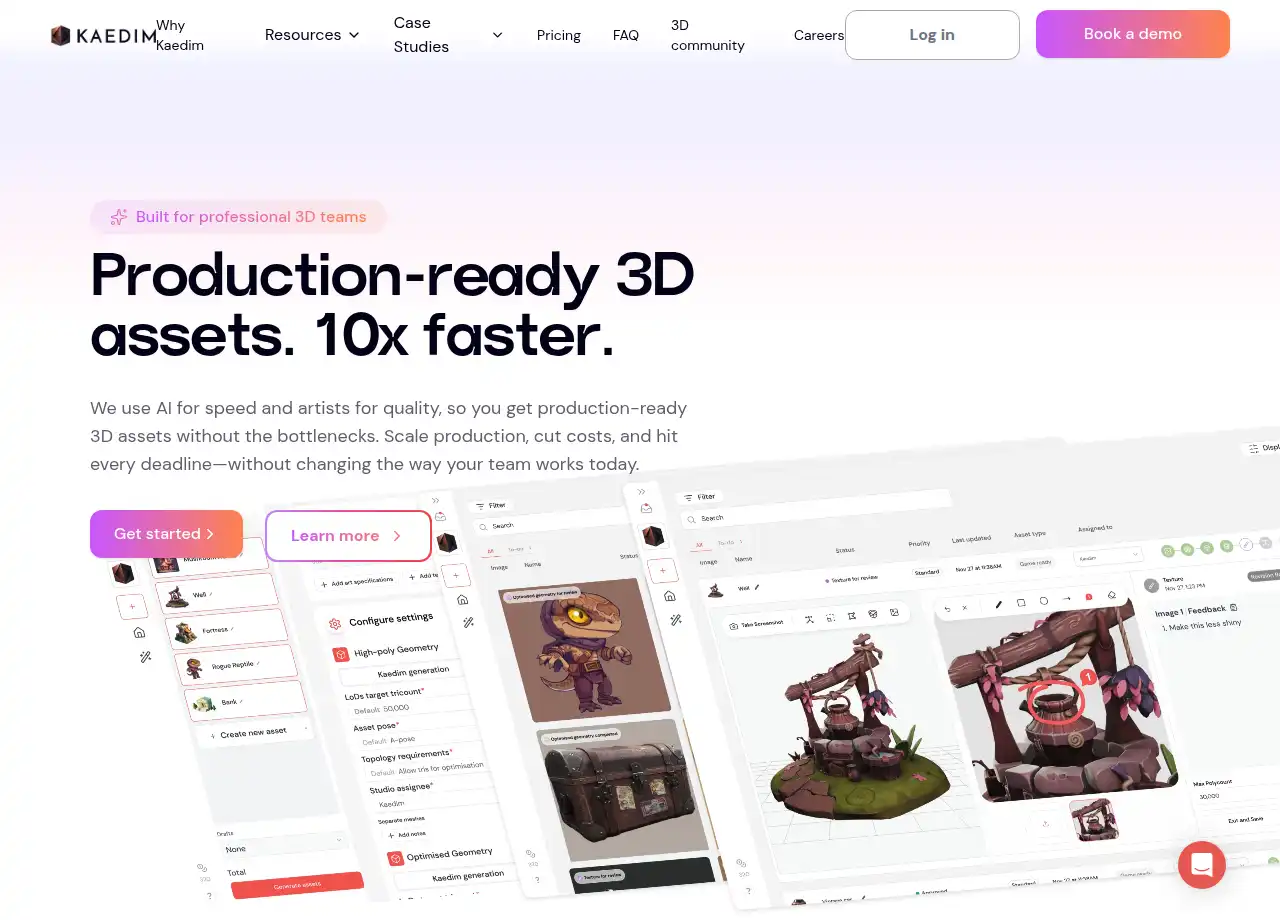
Kaedim AI automates the conversion of 2D sketches into 3D volumetric models, drastically shortening the early massing and form-finding phases of design. While the generated geometry is not intended to be final, it provides a rapid foundation for experimentation, allowing architects to focus on conceptual direction rather than manual modeling. Kaedim is especially useful in competition environments and fast-paced studios where multiple alternatives must be explored in a short period. By accelerating the transition from idea to form, it helps architects iterate more freely and creatively.
13. Sloyd.AI
Sloyd.AI specializes in procedural generation of parametric geometries, façade systems, modular components and patterned surfaces. It brings computational design logic to users who may not have advanced Grasshopper or scripting experience, offering a more accessible way to explore complexity. With adjustable parameters and AI-enhanced suggestions, Sloyd helps architects rapidly test variations of a form, create modular systems or generate unique façade languages. This democratization of parametric tools makes Sloyd a valuable asset in both conceptual and detail-oriented design phases.

14. Luma AI
Luma AI uses NeRF-based 3D capture to transform real physical environments into detailed, navigable digital spaces. A simple smartphone capture can be converted into a high-fidelity 3D model, enabling architects to integrate existing site conditions into their visualizations with precision. This is particularly useful for renovation projects, adaptive reuse studies, context modeling and urban design analysis. Luma’s photorealistic environmental reconstruction bridges reality and digital design, giving architects a richer understanding of the spaces they are working with.

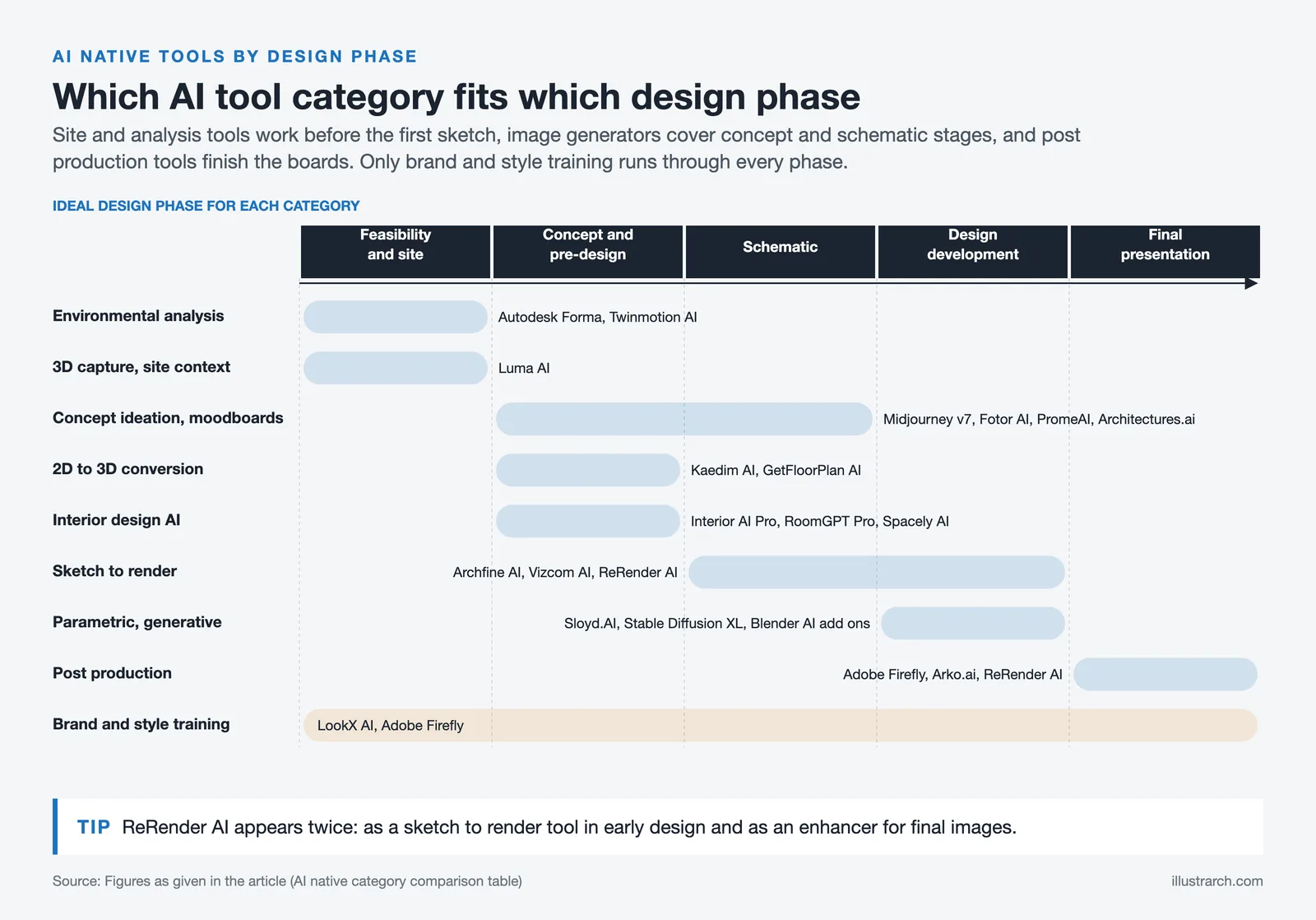
AI-Native Architectural Tools: Category Comparison
| Category | Tools | Input Type | Output Type | Ideal Design Phase |
|---|---|---|---|---|
| Concept Ideation & Moodboards | Midjourney v7, Fotor AI, PromeAI, Architectures.ai | Text prompts, reference images | 2D concept images, mood visuals | Schematic / Pre-design |
| Sketch-to-Render | Archfine AI, Vizcom AI, ReRender AI | Hand sketches, rough 3D models, photos | Photorealistic renders | Schematic / Design Development |
| 2D-to-3D Conversion | Kaedim AI, GetFloorPlan AI | 2D sketches, drawings, floor plans | 3D volumetric models, floor plans | Concept / Early Design |
| Parametric & Generative | Sloyd.AI, Stable Diffusion XL, Blender AI Add-ons | Parameters, datasets, prompts | Parametric geometry, façade systems, textures | Design Development / Detailing |
| 3D Capture & Site Context | Luma AI | Smartphone photos/video | NeRF-based 3D models | Site Analysis / Renovation |
| Interior Design AI | Interior AI Pro, RoomGPT Pro, Spacely AI | Room photographs | Redesigned interior concepts | Concept / Client Consultation |
| Post-Production & Enhancement | Adobe Firefly, Arko.ai, ReRender AI | Raw renders, photographs | Enhanced, polished final images | Final Presentation |
| Brand & Style Training | LookX AI, Adobe Firefly | Reference images, style guides | Consistent branded visuals | Across All Phases |
| Environmental Analysis + Viz | Autodesk Forma, Twinmotion AI | BIM models, site data, climate data | Data-driven visualizations | Feasibility / Urban Planning |
15. ReRender AI
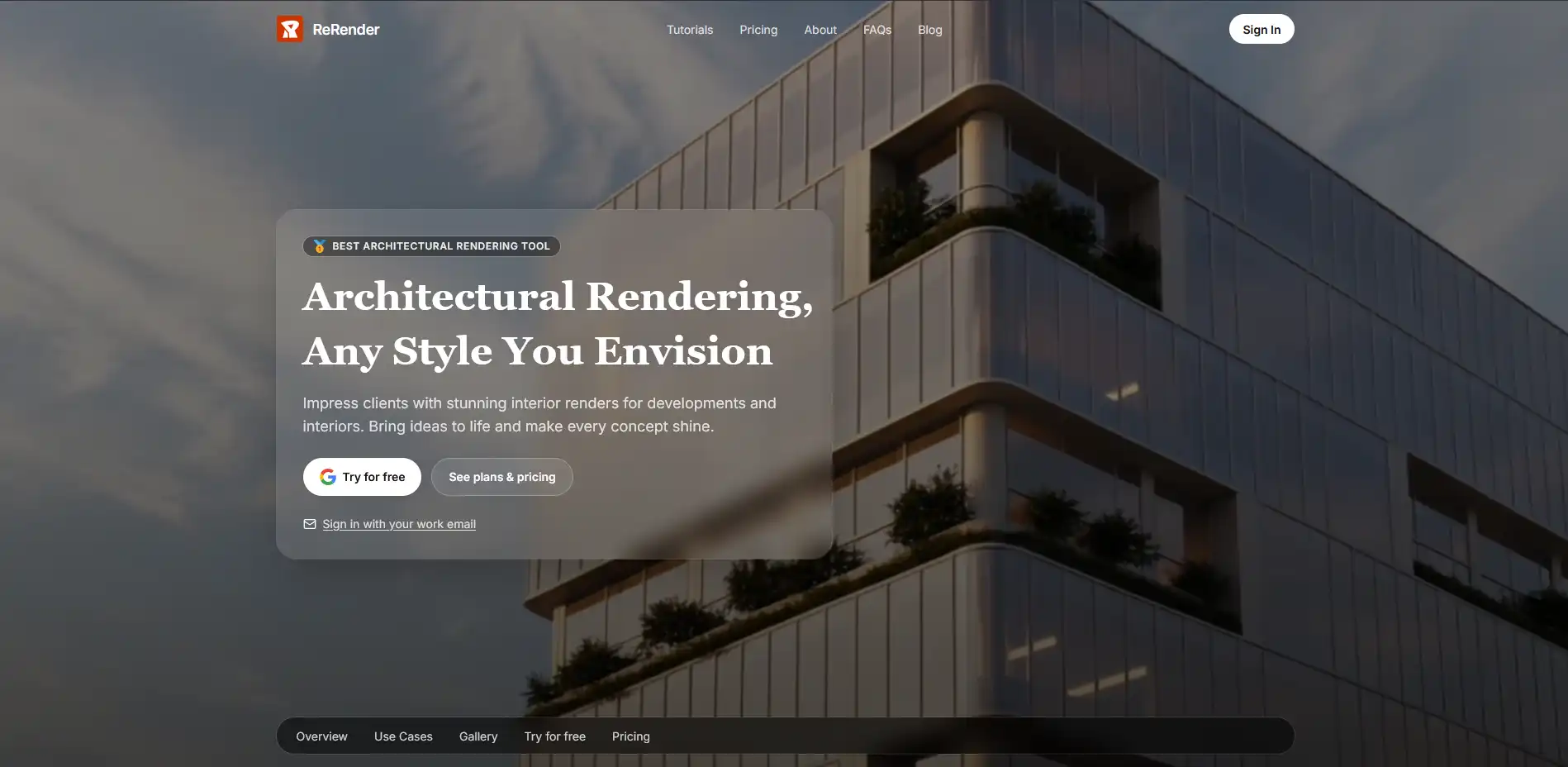
ReRender AI focuses on simplifying and accelerating the rendering preparation process by automatically enhancing materials, optimizing lighting, balancing contrast and cleaning up visual inconsistencies. It delivers high-quality outputs quickly, making it an excellent tool for social media imagery, client previews and fast conceptual presentations. While lighter than traditional render engines, it is powerful enough to produce impressive results with minimal input, making it especially appealing to small studios and freelancers.
16. Fotor AI Architectural Renderer
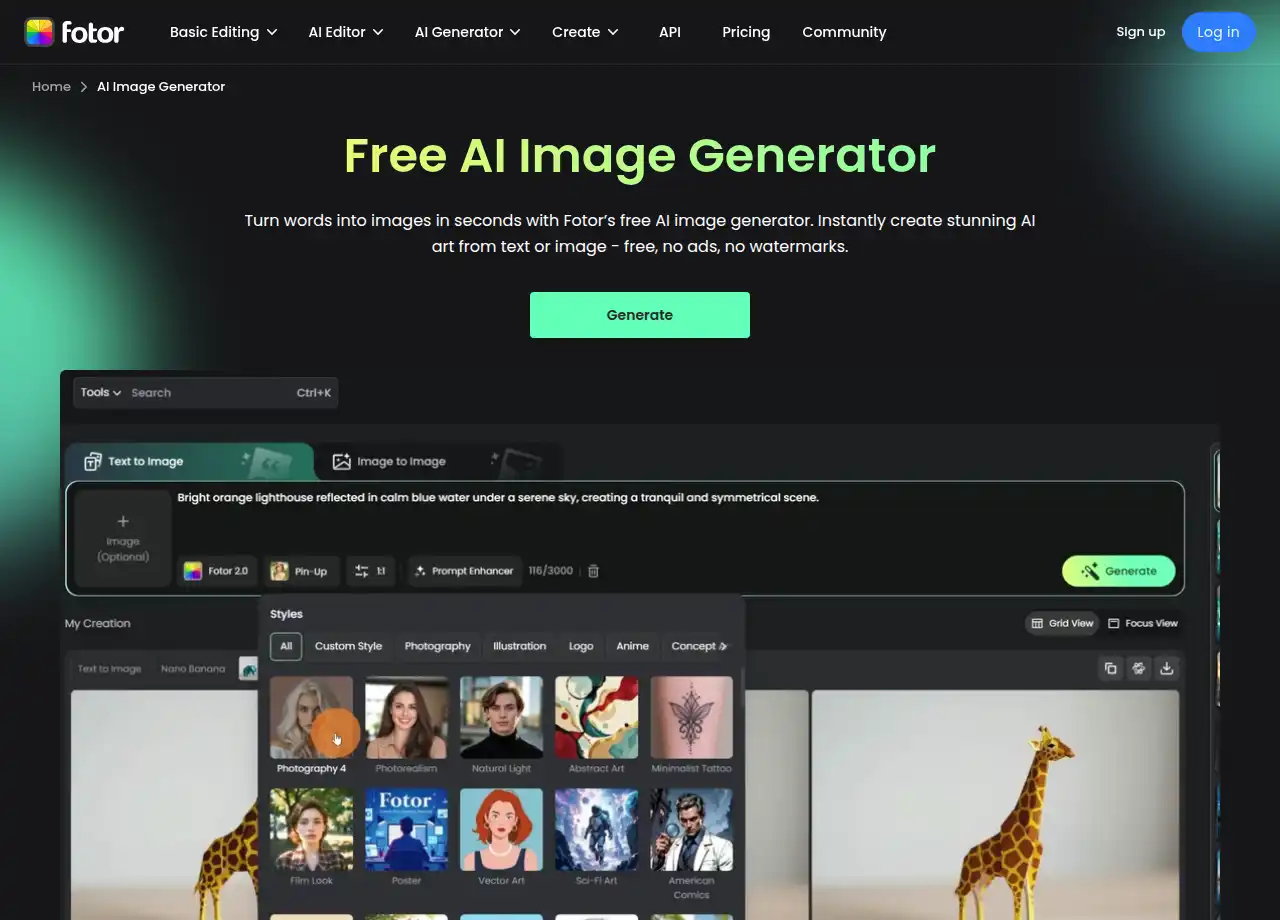
Fotor’s AI Architectural Renderer is designed for fast ideation and conceptual visualization rather than technical rendering. It generates interior, exterior or atmospheric scenes based on text prompts or reference images, making it useful for mood development, stylistic exploration or early visualization of design directions. While simpler than professional tools, Fotor excels in brainstorming scenarios where speed and variety are more important than precision.
17. LookX AI
LookX AI enables architectural teams to create and train custom visual styles that reflect their brand identity or preferred aesthetic. This is particularly valuable for competitions and presentation packages where consistency across all visuals is essential. LookX can generate façade options, interior atmospheres, lighting variations and stylistic narratives that match the visual language of a firm. By unifying concept generation and visual branding, LookX gives offices a powerful tool for both creativity and identity building.

18. PromeAI
PromeAI focuses on style transformation, façade experimentation, material exploration and structural variation. It allows architects to test different visual directions quickly, making it a strong companion during early conceptual development. One of its strengths is the ability to transform complex scenes without breaking spatial logic or distorting geometry. For design teams that need rapid, polished alternatives for client review or competition entries, PromeAI acts as a creative accelerator.

19. Stable Diffusion XL Architecture Models
Stable Diffusion XL architecture-trained models offer full transparency and control for architects who want customizable generative tools. Users can train their own checkpoints, integrate tailored datasets and refine outputs using advanced image-to-image workflows. SDXL excels at conceptual generation, façade development, atmospheric studies and visual storytelling. Because it is open-source, architects have the freedom to shape the tool around their creative needs, making it a favorite among advanced visualization professionals.

20. Vizcom AI
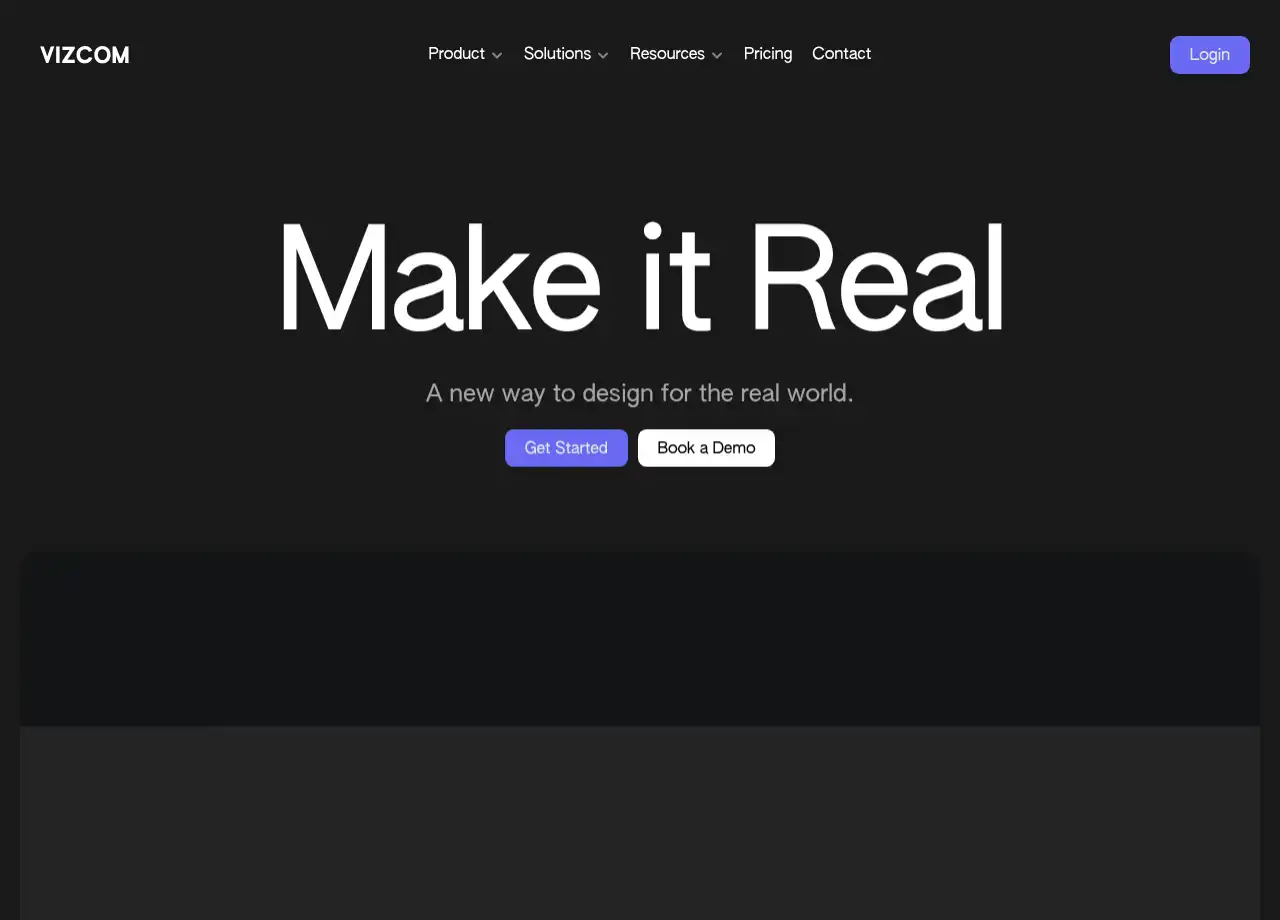
Vizcom AI transforms hand sketches into visually rich render-like images, enhancing linework with realistic lighting, shadows, materials and depth. This makes it invaluable for architects who rely on sketch-based thinking but want to present ideas in a more visually complete form. Vizcom helps bridge the communication gap between rough concept and refined visualization, making early ideas more accessible to clients and collaborators.
21. Arko.ai
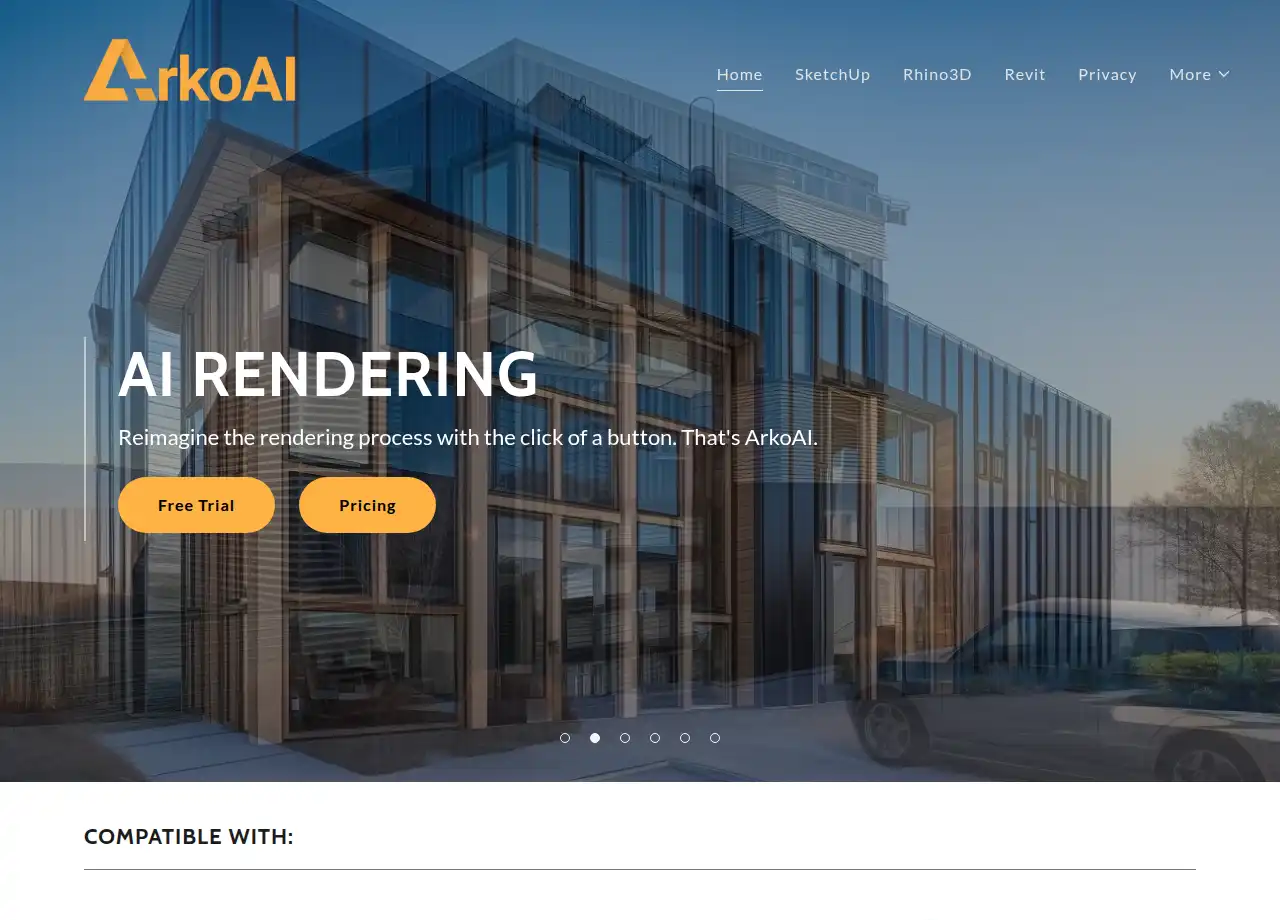
Arko.ai is built for simplicity, speed and accessibility, offering architects a lightweight visualization tool that requires no complex scene setup or technical knowledge. Its AI analyzes images and enhances them with optimized lighting, color balance, material adjustments and atmospheric cohesion. Arko.ai is especially useful for small firms, freelancers and designers who need polished images quickly without entering a full rendering pipeline.
22. Interior AI Pro
Interior AI Pro is designed specifically for interior design workflows, enabling the generation of layout alternatives, furnishing concepts, material palettes and stylistic reinterpretations from a single room photograph. It helps designers explore multiple design directions quickly, making it ideal for renovation projects, residential design and rapid client consultations. Interior AI Pro enhances decision-making by providing a rich set of possibilities early in the process.

23. RoomGPT Pro
RoomGPT Pro specializes in transforming existing interior photographs into redesigned visual concepts across a wide range of styles. It is particularly useful for early discussions with clients, helping them see how a space might change before any drawing or modeling is done. RoomGPT Pro accelerates visualization for renovations, staging, concept testing and early planning.

24. GetFloorPlan AI
GetFloorPlan AI automates the creation of 2D and 3D floor plans from sketches, low-quality drawings or reference photos. It is especially valuable for real estate visualization, early-stage spatial analysis and rapid design iteration. By converting rough ideas into clean diagrammatic plans, GetFloorPlan AI helps architects focus on spatial logic rather than manual drafting.

25. Architectures.ai
Architectures.ai serves as a generative concept engine that produces massing concepts, building silhouettes, façade variations and early-stage design ideas from textual prompts. It supports brainstorming, conceptual competitions and speculative design work, allowing architects to explore a broad range of possibilities in a short amount of time. Architectures.ai is particularly helpful when projects require a wide conceptual scope before narrowing down design directions.

26. Spacely AI
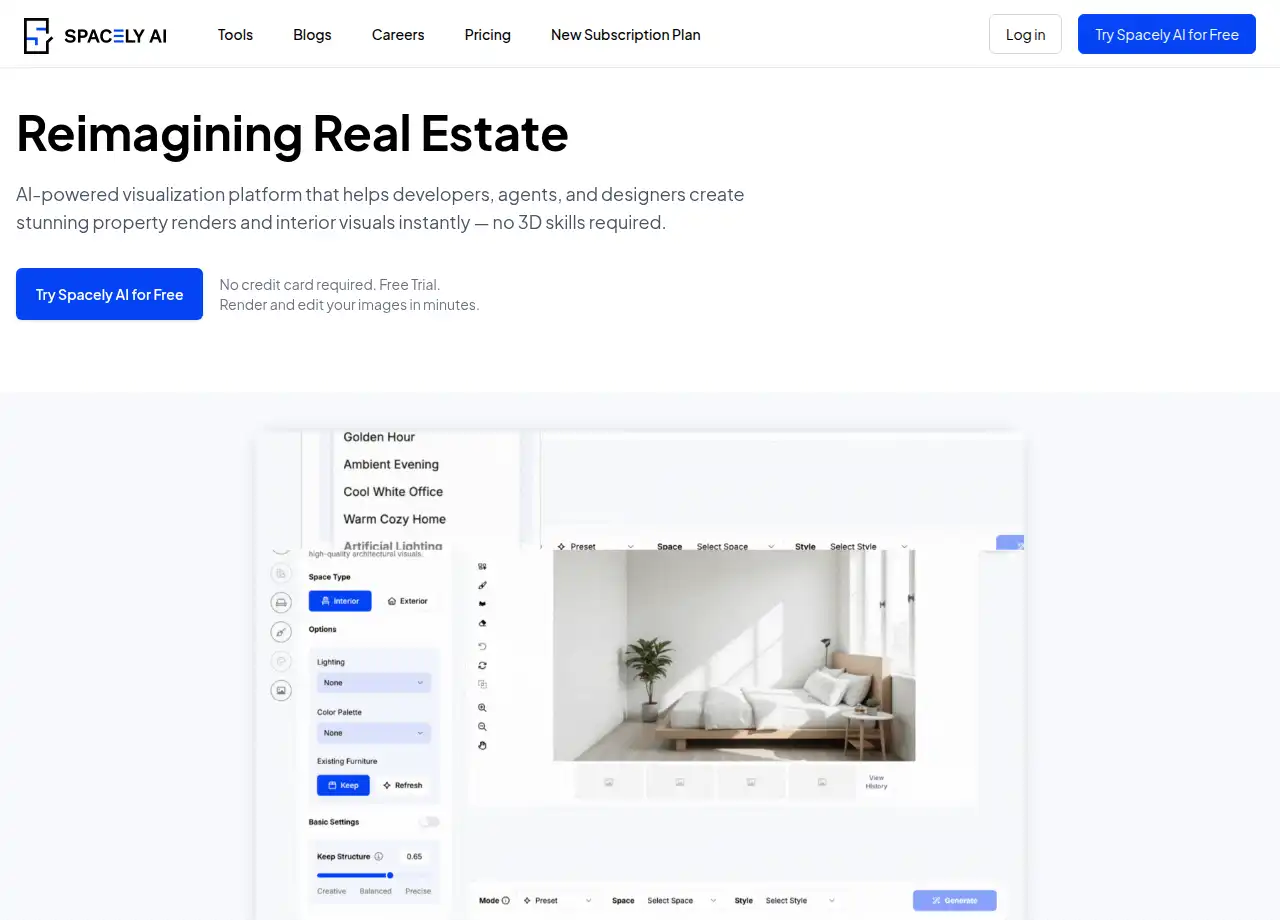
Spacely AI transforms interior and exterior visuals through AI-driven material replacement, lighting optimization, atmospheric enhancement and full scene restyling. It allows architects to test new design directions rapidly, making it ideal for social media content, quick concept presentations and client updates. Spacely enables designers to evaluate visual alternatives without revisiting the full modeling workflow.
Which AI Rendering Tool Is Right for You?
| Architect Profile | Primary Need | Recommended Tools | Why These Tools |
|---|---|---|---|
| Large Architecture Firm | High-end marketing imagery, team collaboration | V-Ray Vision AI, Lumion 2026, D5 Render Teams | Photorealistic quality, asset libraries, team licensing |
| Solo Practitioner / Freelancer | Fast results, low budget | Archfine AI, Arko.ai, ReRender AI, D5 Community | Affordable or free, minimal setup, quick outputs |
| Competition-Focused Designer | Rapid concept exploration, visual storytelling | Midjourney v7, LookX AI, PromeAI, Archfine AI | Fast ideation, style consistency, atmospheric visuals |
| BIM-Integrated Studio | Seamless model-to-render workflow | Enscape Neural Render, D5 Render, Twinmotion AI | Direct BIM plugin, real-time sync, iterative design |
| Interior Designer | Room visualization, material exploration | Interior AI Pro, RoomGPT Pro, Spacely AI | Photo-to-concept conversion, style variation |
| Urban Planner / Landscape Architect | Environmental analysis, masterplan visualization | Autodesk Forma, Twinmotion AI, Lumion 2026 | Climate data integration, large-scale rendering |
| Technical Visualization Specialist | Full control over rendering pipeline | Blender AI Add-ons, Stable Diffusion XL, V-Ray | Open-source flexibility, custom workflows |
| Real Estate & Marketing Team | Quick floor plans, social media content | GetFloorPlan AI, Fotor AI, ReRender AI, Spacely AI | Fast turnaround, no technical expertise required |
Conclusion
As AI-driven visualization becomes deeply embedded in architectural workflows, 2026 marks a pivotal moment in the evolution of design technology. The tools explored in this guide demonstrate how architects now operate in an environment where the barriers between imagination and representation are increasingly thin. AI has not replaced the creative mind behind the work; instead, it has expanded its capabilities, offering architects a vastly larger canvas on which to explore possibilities. Designers can visualize atmospheric moods, test material palettes, refine lighting conditions, evaluate massing alternatives and generate competitive-ready imagery in a fraction of the time once required. This speed does more than expedite deadlines—it changes the very nature of iterative design, opening the door to more exploration, more innovation and more meaningful visual communication.
Looking ahead, the integration of AI in architectural rendering is likely to deepen further, blending real-time environmental analysis, contextual intelligence, performance data and generative creativity into unified design ecosystems. The firms and designers who embrace these tools today will not only work more efficiently but will also position themselves at the forefront of a rapidly transforming profession. As the lines between rendering, modeling, simulation and storytelling continue to dissolve, AI will become a central partner in shaping how architecture is conceived, communicated and experienced. For architects prepared to engage with these technologies, the future offers a richer, more expressive and more powerful visual language than ever before.
Related Guides
- ReRender AI Review: The Fastest AI Architecture Renderer for Revit, SketchUp and Rhino Users
- Maket.ai Review 2026: Can AI Really Generate Zoning-Compliant Floor Plans in Seconds?
- ArchiVinci 2.1: Pushing Architectural Rendering to New Heights
- Enscape Alternative: 6 Best Rendering Tools for Architects in 2026
- Alternative to Lumion: 6 Best Rendering Tools for Architects
- Lumion 12.5 vs Lumion 2023: What’s Best?
More Related Guides
- How To Create Best 3D Architectural Rendering
- Beautiful Exteriors With Lumion 12
- Best Youtube Channels For Learning Lumion
- Advantages Of Keyshot Rendering
- Importance Of Realistic 3D Rendering For Interior Architects
- Beautiful Interiors With Lumion 12
- 3D Rendering Company What Collaborating With One Is Like
- Online Tutorials For Learning Lumion
- Keyshotweb Renderer Via Browser
- What Is New In Lumion 12
- 2026 architectural rendering software
- advanced rendering tools for architecture
- AI architectural design
- AI architectural rendering tools
- AI architecture design tools
- AI-based architecture tools
- AI-powered architectural rendering
- architectural visualization tools 2026
- best rendering tools for architects 2026
- future of architectural visualization



Seedance 3.0 for Home and Garden Concepts: Making a Renovation Story Easier to Discuss
Seedance 3.0 can turn a renovation idea into a short concept video....
 illustrarch Editoral Team5 Mins read

Best AI Interview Assistant for Architects: 9 Tools Compared
We compare nine AI interview assistants for architects on speed, drawing awareness,...
illustrarch Editoral Team12 Mins read

ARki Review: AR Room Planner and 3D Visualization on Mobile
ARki has been a fixture in architectural augmented reality since before AI...
 Sinan Ozen5 Mins read
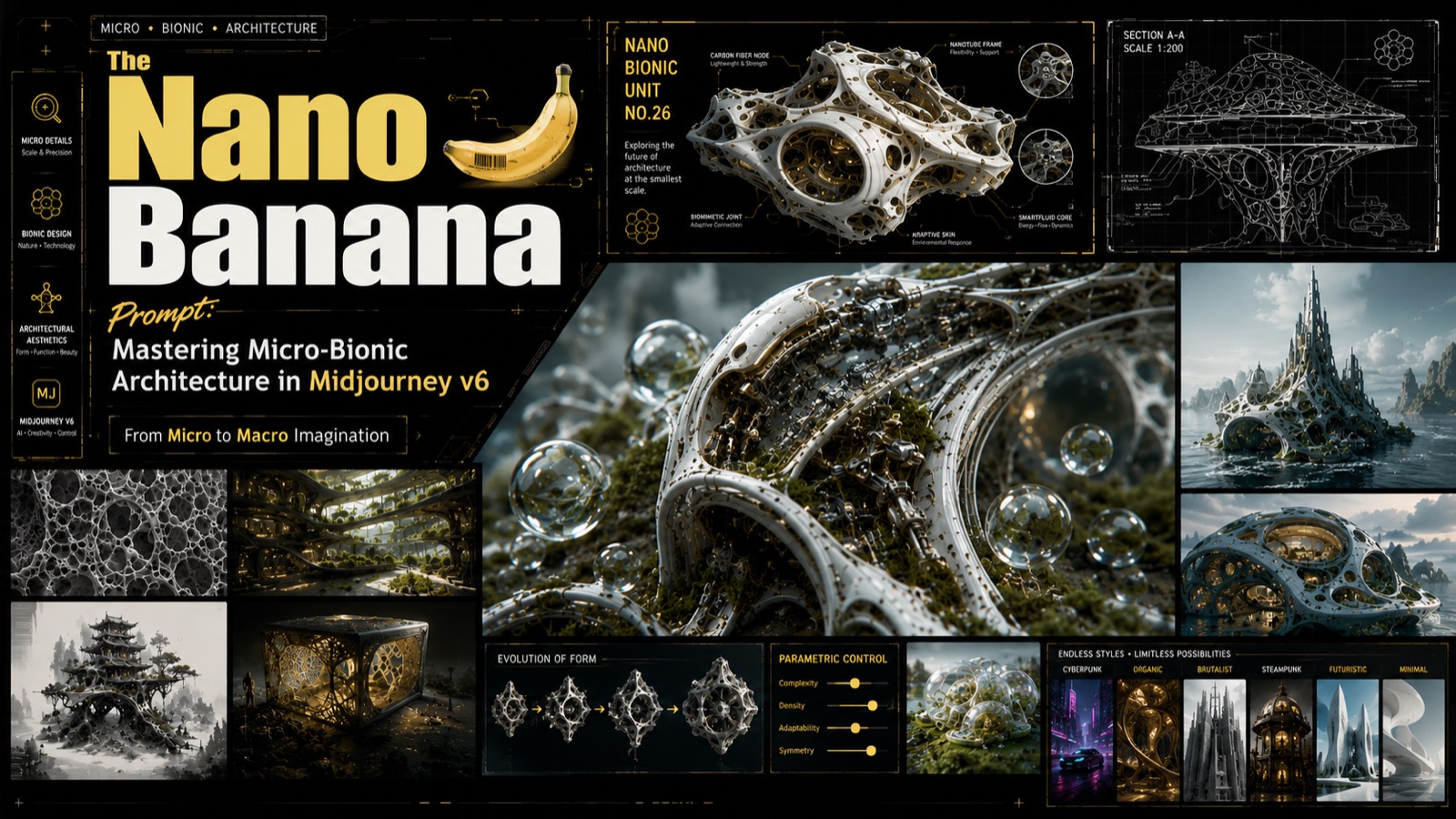
The Nano Banana Prompt: Mastering Micro-Bionic Architecture in Midjourney v6
Nano Banana Prompt explores the innovative fusion of biomimicry and architectural design...
Bahattin Duran3 Mins read


Leave a comment